
Buying a PCB router machine involves more than comparing equipment prices and technical specifications.
This guide answers 20 common questions about machine selection, cutting performance, maintenance, operating costs, and purchasing considerations.
1. Basic Questions About PCB Router Machines
Q1. What is a PCB router machine?
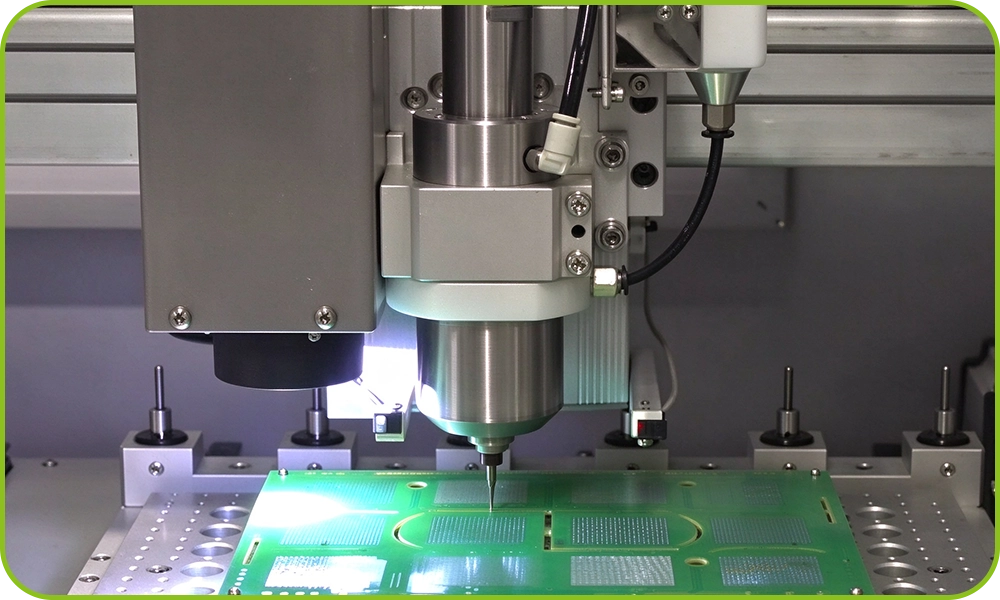
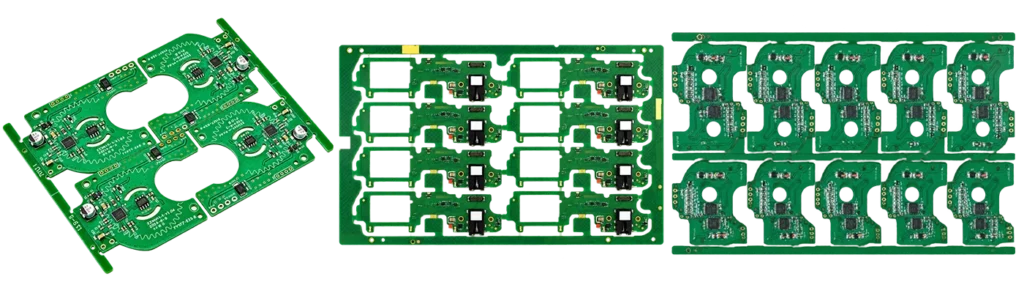
A PCB router machine uses a high-speed rotating router bit to separate individual PCBs from a panel along programmed cutting paths. It is commonly used for assembled PCBs with complex outlines or sensitive components.
Its main characteristics include:
- High-precision cutting: Supports complex PCB contours.
- Low mechanical stress: Reduces board bending compared with manual separation when properly supported.
- Flexible programming: Processes different PCB designs through programmable paths.
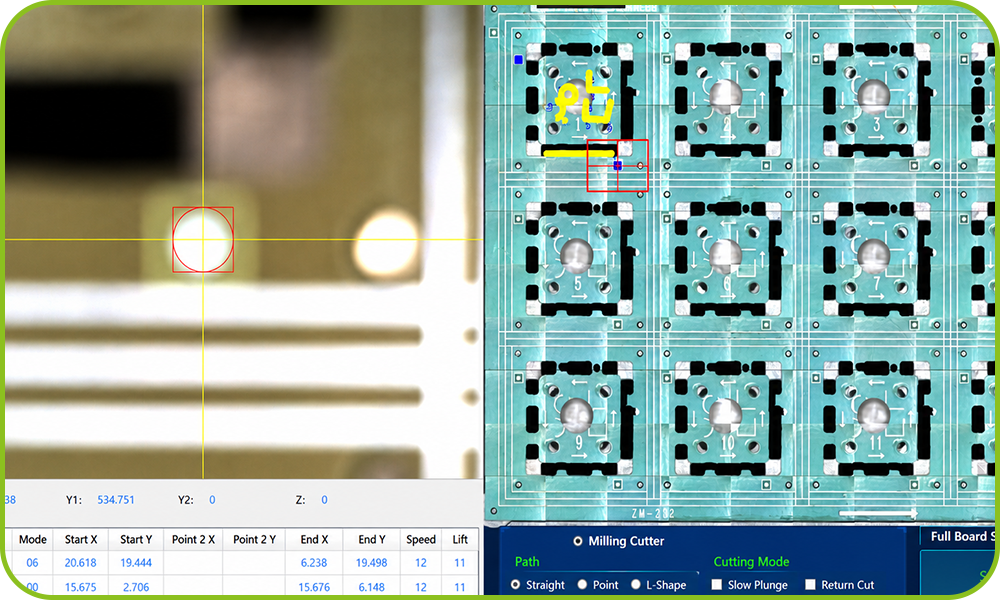
- CCD positioning: Improves cutting-position consistency.
- Automated production: Inline models support automatic loading and unloading.
PCB router machines are widely used in consumer electronics, automotive, communication, and medical electronics manufacturing.
Q2. What types of PCBs can a router machine process?
PCB router machines commonly process rigid FR-4 PCBAs, multilayer PCBs, high-density assemblies, and irregularly shaped boards.
Specialized materials, including certain aluminum-backed or high-frequency laminates, may also be processed with suitable router bits. Material compatibility, thickness, and tool clearance determine processing suitability.
Q3. What is the difference between an inline and an offline PCB router machine?
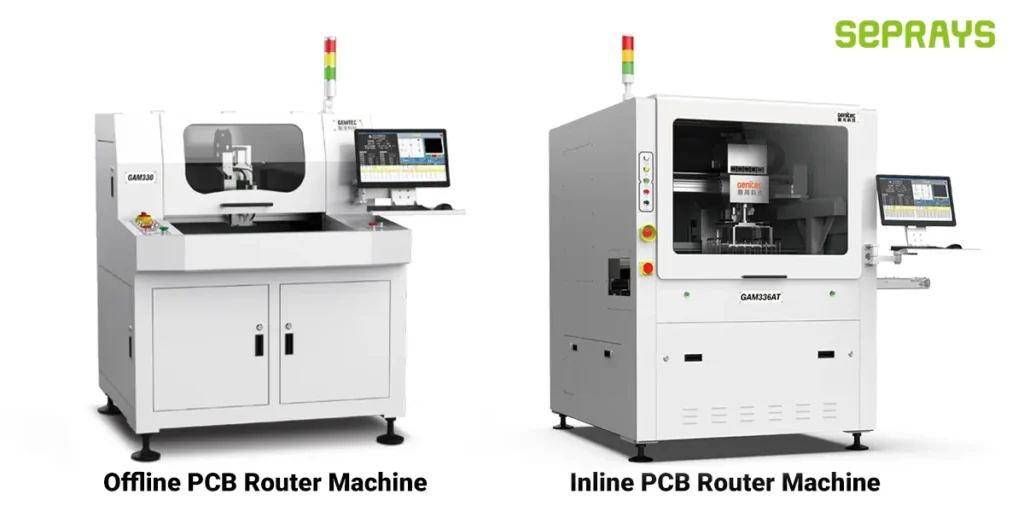
| Comparison | Inline PCB Router | Offline PCB Router |
|---|---|---|
| Operation | Integrated with SMT lines | Standalone operation |
| Loading | Automated | Manual or semi-automatic |
| Best for | High-volume production | Smaller batches and frequent changeovers |
| Investment | Generally higher | Generally lower |
Buying tip: Inline machines are suitable for continuous automated production, while offline machines offer greater flexibility for smaller production batches. Available floor space and labor requirements also matter.
Q4. Can one PCB router machine process different PCB designs?
Yes. A programmable PCB router can process different PCB designs by changing cutting programs and, when necessary, fixtures.
SEPRAYS PCB Router Machines support cutting paths such as:
- Straight lines
- L-shaped paths
- U-shaped paths
- Circles
- Arcs
These programmable cutting functions make one compatible machine suitable for multiple PCB designs, reducing the need for separate equipment.
Q5. What is the difference between single-table and dual-table PCB router machines?
A single-table machine processes one worktable at a time. A dual-table machine can allow one worktable to be loaded or unloaded while the other is being processed, depending on its configuration.
Dual-table machines can reduce waiting time and improve production efficiency, especially for repetitive, high-volume operations. Single-table models may be more economical for smaller production requirements.
2. Machine Specifications and Performance
Q6. What factors determine the cutting quality of a PCB router machine?
Cutting quality mainly depends on router-bit condition, spindle speed, feed rate, fixture stability, and positioning accuracy.
Worn tools or unstable fixtures may cause burrs and cutting deviations. Properly matched cutting parameters and stable PCB support help maintain consistent edge quality.
Q7. Does a higher spindle speed always mean better cutting quality?
No. Higher spindle speed does not automatically produce smoother cutting edges.
The appropriate speed depends on PCB material, thickness, router-bit diameter, and feed rate. Unsuitable settings may increase tool wear or affect cutting quality.
Q8. How do I calculate PCB router machine production capacity?
A basic calculation is:
For example, processing six PCBs in 30 seconds gives a theoretical output of 720 PCBs per hour.
Actual production capacity depends on loading, unloading, cutting paths, changeovers, and downtime. Use a complete production-cycle measurement for realistic estimates.
Q9. What is CCD positioning, and is it necessary?
CCD positioning uses a camera to recognize PCB fiducial marks and correct cutting-position offsets.
It is particularly useful for high-density PCBAs, narrow cutting clearances, and automated production. For simpler PCB designs, mechanical positioning may be sufficient if the required accuracy is maintained.
Q10. What should I check about the machine’s working area?
Compare your largest PCB panel dimensions with the machine’s effective cutting area.
Also consider PCB thickness, component height, fixture dimensions, and loading clearance. The maximum usable panel size may differ from the nominal cutting area.
3. Operation, Maintenance, and Costs
Q11. How often do PCB router bits need replacement?
Router-bit life depends on PCB material, thickness, cutting distance, and processing parameters.
Monitor cumulative cutting length, burr formation, and cutting quality. Tool-life monitoring functions can make replacement schedules more consistent.
Q12. Does a PCB router machine require a dust collector?
Yes. Router depaneling generates PCB dust and debris that may accumulate inside the machine or remain on PCB surfaces.
An effective dust extraction system helps maintain cleanliness and stable cutting conditions. Filters and suction pipes should be inspected regularly.
Q13. How long does it take to change from one PCB model to another?
Changeover time depends on whether a new cutting program, fixture, or router-bit configuration is needed.
For previously processed PCB models, operators can reuse stored programs and replace fixtures when necessary. Quick-change fixtures and stored recipes help reduce setup time.
Q14. What daily maintenance does a PCB router machine require?
Routine maintenance should include:
- Cleaning the cutting area and fixtures.
- Inspecting router bits for wear.
- Checking spindle noise and vibration.
- Checking CCD positioning.
- Inspecting the dust collection system.
Regular basic maintenance helps maintain cutting consistency and reduce unexpected downtime. Periodic servicing should follow the machine’s operating manual.
Q15. What affects the price of a PCB router machine?
Machine prices depend on configuration, automation level, cutting area, positioning system, and additional functions.
| Factor | Price Consideration |
|---|---|
| Inline or offline | Automation level |
| Working area | Machine size and capacity |
| CCD positioning | Vision hardware and software |
| Automatic tool changing | Additional automation |
| Loading/unloading | Material-handling equipment |
| Fixtures and dust extraction | Included or optional accessories |
Buying tip: Compare quotations with equivalent configurations. The lowest equipment price may not include all necessary accessories.
Q16. How can I calculate the total cost of owning a PCB router machine?
Total cost of ownership includes the machine purchase, installation, router bits, electricity, maintenance, labor, and production downtime.
This approach provides a more meaningful long-term comparison than machine purchase prices alone.
4. Purchasing, Installation, and Quality
Q17. What information should I prepare before requesting a quotation?
Prepare the following information:
- PCB material and thickness.
- Panel dimensions and cutting drawings.
- Component layout and cutting clearance.
- Required cutting accuracy.
- Target production capacity.
- Inline or offline preference.
These details help determine the required machine size, fixture configuration, and automation functions. Clear specifications also make equipment quotations easier to compare.
Q18. What should be included in a PCB router machine quotation?
A quotation should identify the machine model, cutting area, spindle, vision system, tool-changing functions, fixtures, dust extraction, and automation configuration.
Also check the warranty, installation, training, delivery terms, and spare parts. Comparing the complete supply scope helps avoid unexpected additional costs.
Q19. What international quality standards are relevant to PCB router depaneling?
Two commonly referenced IPC standards are:
| Standard | Relevance |
|---|---|
| IPC-A-610J | Electronic assembly acceptance and damage assessment |
| IPC-A-600M | Bare-board acceptability and relevant PCB defects |
These internationally used industry standards help evaluate PCB quality, but do not establish one universal cutting tolerance for all router machines.
For updates, refer to the official IPC Standards Revision Table.
Q20. How can I evaluate a PCB router machine before purchasing?
Testing with your actual PCB panel is one of the most useful evaluation methods.
Focus on four results:
- Cutting accuracy: Does the finished board meet dimensional requirements?
- Edge quality: Are burrs, cracks, and delamination acceptable?
- Component integrity: Are components and solder joints protected?
- Cycle time: Does the machine meet production requirements?
A successful trial should demonstrate both acceptable cutting quality and stable production performance.
5. Conclusion: Choosing Your First PCB Router Machine
Choosing a PCB router machine requires balancing cutting quality, production efficiency, flexibility, automation, and total operating costs.
Offline machines are practical for smaller batches and frequent changeovers, while inline machines are generally better suited to continuous high-volume production.
The best purchasing decision is based on your actual PCB requirements, realistic production calculations, and representative cutting tests—not simply the lowest price.
Need a PCB router machine for your production line? Share your PCB drawings, material specifications, panel dimensions, and target production capacity with SEPRAYS to discuss suitable equipment configurations.
Contact SEPRAYS for a PCB Router Machine Solution
Email: millie@seprays.com
WhatsApp: +86 139 2552 7370