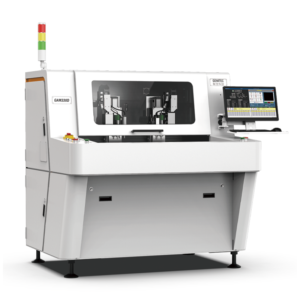

When a 0.8mm-thick FR-4 panel populated with 01005 components exits the SMT line at 45 boards per minute, the depaneling step alone can introduce microcracks invisible to AOI inspection yet fully capable of degrading field reliability by 30% or more over thermal cycling. Offline depaneling machines — standalone systems that remove individual boards from arrayed panels outside the main production conveyor — solve a specific class of this problem by isolating the mechanical stress event from upstream processes and giving operators direct control over tooling, speed, and fixturing. Understanding which production environments actually benefit from this separation is the difference between a capital expense that cuts defect rates and one that simply adds cycle time.
High-Mix, Low-Volume Electronics Manufacturing
The single strongest argument for offline depaneling appears in facilities running 50 or more unique panel designs per month with batch sizes below 500 units. Inline routing or punching systems require fixture changes, program validation, and conveyor alignment for each new product — a setup procedure consuming 15 to 40 minutes depending on complexity. An offline router, by contrast, can accept a new panel, load a stored program via USB or network, and begin cutting within 90 seconds using vacuum fixture plates with universal locating pins. For a contract manufacturer juggling medical, automotive, and consumer designs on shared lines, this flexibility reduces changeover losses by an estimated 60 to 70%. Spindle speeds of 40,000 to 60,000 RPM with 1.0mm to 2.0mm two-flute carbide end mills achieve routing speeds of 20 to 50 mm/s on standard FR-4, maintaining board-edge quality within ±0.05mm of programmed paths without product-specific hard tooling.
Prototype and New Product Introduction Environments
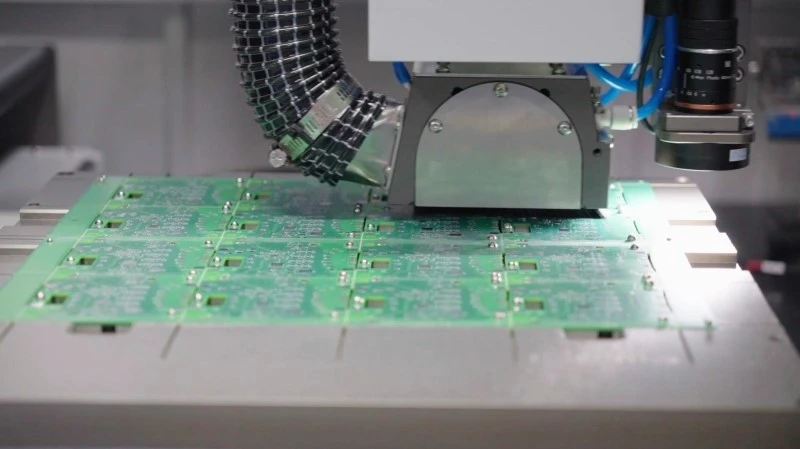
During NPI, panel layouts change frequently — sometimes daily — as design engineers iterate on fiducial placement, tooling holes, and breakaway tab geometry. An inline depaneler integrated into the SMT line becomes a bottleneck every time a new panel revision arrives. Offline machines address this directly. Operators can cut single panels or partial arrays for first-article inspection without disrupting production flow. Many offline platforms support vision-based registration with ±0.02mm alignment accuracy, which is critical when prototype boards use tight routing clearances of 0.5mm or less between components and the board edge. Because the depaneling happens post-reflow but pre-assembly, engineers can evaluate edge quality, check for delamination along routed channels, and verify that BGA solder joints within 3mm of the cut line show no cracking under X-ray before committing to volume tooling. Per IPC-6012 Class 3 requirements, edge damage must not extend more than 0.8mm from the board outline — a tolerance easily met with proper offline router setup but frequently violated by manual V-scoring or snap-breaking methods still common in proto labs.
Panels with Sensitive or Asymmetric Component Distribution
Not all boards depanel cleanly. When high-profile components such as electrolytic capacitors, transformers, or shield cans sit within 2mm of the routing path, vibration-induced failure becomes a real concern. Offline machines offer a decisive advantage here because the operator can rotate the panel orientation, adjust the feed rate to as low as 10 mm/s in critical zones, and in some configurations switch to an upward-cutting spindle to direct debris and cutting forces away from component surfaces. Stress measurements taken with strain gauges on test coupons consistently show that controlled offline routing generates peak localized stress values below 150 microstrain, compared to 400 to 600 microstrain for manual snap-breaking along V-score lines. For boards carrying ceramic chip capacitors rated at X7R dielectric — which are susceptible to microcracking at stress levels above 200 microstrain — this difference directly correlates with reduced infant mortality in accelerated life testing per IPC-9701 guidelines.
Post-SMT Secondary Operations and Rework Stations
Some production workflows intentionally hold panels after reflow for additional operations — selective soldering of through-hole components, conformal coating of specific zones, or functional test probing at the array level. In these scenarios, an inline depaneler placed immediately after reflow would force premature separation before secondary processes complete. Offline depaneling slots naturally after all panel-level operations finish, whether that is 20 minutes or 4 hours post-reflow. This sequencing prevents handling damage to already-separated boards and allows quality personnel to inspect and repair the full panel array before committing to individual board singulation. Facilities running mixed-technology assemblies — surface mount combined with wave-soldered or hand-soldered through-hole — frequently adopt this approach, reporting 15 to 25% reductions in handling-related defects compared to inline separation before secondary processing.
Facilities with Floor-Space or Throughput Constraints
Not every factory has the linear footprint to add another inline station between reflow and AOI. Offline depanelers are compact — many fit within a 1.2m by 0.8m footprint — and can be positioned at any convenient location, including shared work cells staffed by operators responsible for multiple post-SMT tasks. For plants running below 1,500 panels per shift, a single offline router typically provides sufficient capacity without creating a throughput bottleneck, especially when batch processing queues panels during operator breaks or shift transitions. The economic threshold is straightforward: when panel variety and changeover frequency outweigh raw volume demands, offline equipment delivers lower total cost of ownership despite requiring manual material handling between stations.
Offline depaneling machines occupy a specific and well-defined niche in electronics manufacturing — they excel where production variety, component sensitivity, process sequencing, or physical layout make inline separation impractical or unnecessarily risky. The engineering decision is not about offline versus inline as a binary choice, but about matching separation methodology to the stress tolerance of the board, the cadence of product changeovers, and the layout of the surrounding production flow. In high-mix environments running Class 2 and Class 3 assemblies, offline routing with proper fixturing, vision registration to ±0.02mm, and controlled feed rates consistently achieves edge quality and component protection that justify the manual handling trade-off.
Recommended Equipment
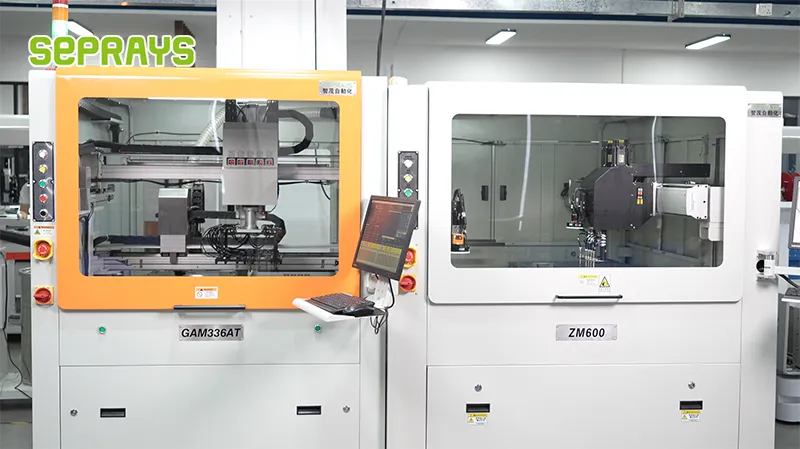
Looking for proven depaneling solutions? Seprays offers a full range of equipment backed by 30+ years of industry experience. Here are two options worth considering for your production line:
- ZM30-D Multi-Tool Multi-Group PCB Depaneling Machine — One-time full LED board cutting — daily output exceeding 100,000 pieces with custom configurations
- GAM 340AT In-Line Automatic PCB Router Machine — Dual workbench with auto-focus vision camera — maximizes throughput for inline SMT integration
Frequently Asked Questions
Q1: Our SMT line runs 20 different PCB variants per week with batch sizes between 50-500 boards. Would an offline depaneler be more suitable than integrating an inline system?
A1: Yes, offline depanelers excel in high-mix, low-volume environments where frequent tooling changes would cause significant downtime on an inline system. The ability to quickly switch between different PCB formats without recalibrating the entire production line makes offline units ideal for this scenario.
Q2: What PCB thickness and component density thresholds indicate that an offline router should be used instead of a depaneling saw?
A2: Offline routers are recommended for PCBs with thicknesses above 1.6mm or when components are positioned near the board edge, as the milling process generates less mechanical stress than saw cutting. The programmable routing path also accommodates irregular board shapes that V-scoring cannot handle.
Q3: Can offline depanelers handle panels with mixed V-score and routed breakaway tabs on the same production run?
A3: Many offline depaneling systems support dual-mode operation with both routing spindles and V-score cutting capabilities, allowing mixed panelization methods without changing machines. You should confirm the specific model’s configuration, as some entry-level units are dedicated to either routing or V-scoring exclusively.
About Seprays
About Seprays Precision Machinery
Founded in 1993, Seprays has over 30 years of expertise in PCB depaneling solutions. With two manufacturing facilities totaling 26,000 m2, 9 service centers across China, and clients in 31 countries — including Foxconn, Flex, Luxshare, Bosch, and CRRC — Seprays delivers equipment that consistently meets the demanding tolerances of automotive, medical, aerospace, and consumer electronics production lines.
Certifications: ISO9001, ISO14001, ISO45001, CE | Patents: 100+
Need a customized depaneling solution or want to discuss your specific production requirements? Our technical team is ready to help.
Contact: jimmy@seprays.com