
The Stakes Are Immensely Higher in Automotive Electronics Manufacturing
When you manufacture PCBAs for automotive control units, the difference between a properly depaneled board and a faulty one isn’t just a cosmetic issue—it can be a matter of life and death. We learned this the hard way at a production facility in Chongqing three years ago, where recurring trace damages at the depaneling stage were causing intermittent failures in electronic braking modules. The production manager told us they’d spent six weeks troubleshooting before realizing the root cause wasn’t in the soldering process or component placement, but in a seemingly routine post-assembly cutting operation that looked perfectly fine on the surface.
This scenario repeats itself across automotive electronics factories worldwide, and the pattern is consistent: manufacturers discover accuracy problems in their depaneling process only after costly field failures emerge. The automotive electronics supply chain demands precision levels that dwarf consumer electronics standards, yet many factories continue using depaneling equipment designed for a different era and different expectations.
Understanding Why Automotive Electronics Tolerates Zero Margin for Error
The automotive industry’s unique requirements stem from a fundamental reality: electronic control systems in vehicles operate in environments of extreme vibration, thermal cycling, and mechanical stress. A single stress concentration point caused by an imprecisely cut PCB edge can propagate into a fatigue failure that takes months or years to manifest.
Consider the mathematics of tolerance stack-up in a typical automotive BCM (Body Control Module) that integrates 12 distinct PCB sections within a single enclosure. If each depaneling operation accumulates even 0.05mm of positional error across multiple cuts, the cumulative effect creates clearance violations when these modules are assembled into increasingly miniaturized automotive housings. The factory floor supervisor we interviewed at a major tier-one supplier in Chengdu described it this way: “In consumer electronics, a 0.1mm error might cause cosmetic concerns. In our products, that same 0.1mm creates a potential stress crack that will return to us as a warranty claim three years down the road.”
Automotive standards including IATF 16949 and AEC-Q series specifications mandate specific geometric tolerances that directly constrain PCB depaneling operations. The IPC-6012DA specification for automotive daughter cards requires edge quality standards that traditional sawing or simple punch-depanel approaches struggle to achieve consistently at production volumes. This isn’t theoretical—the automotive supply chain has documented cases where inadequate depaneling accuracy contributed to field failures that triggered massive recalls affecting hundreds of thousands of vehicles.
Real Accuracy Challenges Factory Operators Confront Daily
The depaneling accuracy problem manifests differently across production contexts, and understanding these variations is essential for identifying appropriate solutions.
Stress-induced microcracks represent the most insidious failure mode. When routing tools deflect during the cutting process, they generate subsurface damage that remains invisible during standard incoming inspection. Only after thermal cycling or vibration exposure does the crack propagate sufficiently to create intermittent open circuits. An experienced quality engineer at an automotive electronics plant in Wenzhou told us she discovered through root-cause analysis that 34% of their customer returns stemmed from depaneling-induced stress rather than the solder joint failures initially suspected.
Positional accuracy drift constitutes a second challenge. As routing equipment experiences thermal expansion during extended production runs, axis positioning accuracy degrades progressively. A machine calibrated perfectly at 8 AM might accumulate 0.08mm of positional error by noon, creating borderline acceptance failures that pass through quality checks conducted during calibration but fail during production. This temperature-dependent drift particularly affects factories without climate-controlled assembly areas, which describes most facilities in developing manufacturing regions.
Edge metallization damage presents a third failure pathway. The exposed copper at PCB edges becomes susceptible to oxidation and subsequent adhesion failures when depaneling operations generate excessive heat or mechanical force. In automotive applications where modules must endure 15+ year service lives, edge corrosion from compromised metallization integrity creates reliability trajectories that diverge from designed expectations.
Tab-routing residual stress frequently plagues automotive boards that incorporate multi-up panel designs with intricate tab configurations. The stress concentration at tab removal points becomes amplified when boards subsequently undergo wave soldering thermal shock. We observed this failure mode repeatedly during our technical exchanges with automotive electronics manufacturers who were transitioning from consumer to automotive production without updating their depaneling approaches.
Technical Parameters That Define Adequate Accuracy for Automotive Applications
Translating automotive requirements into specific technical parameters illuminates why specialized equipment matters. A thorough understanding of these specifications helps procurement decisions and installation protocols.
Positional accuracy specifications for automotive depaneling typically require ±0.03mm or tighter at the cutting path, measured under actual production conditions rather than theoretical machine specifications. This represents approximately one-third the tolerance common in standard consumer electronics manufacturing. Achieving this level requires equipment with high-resolution axis control systems, thermal compensation mechanisms, and rigidity sufficient to eliminate deflection-induced errors.
Edge quality assessment according to IPC-6012DA examines multiple parameters: surface roughness ( Ra < 3.2μm for critical applications), absence of delamination, minimal heat-affected zones, and absence of visible cracks extending from the edge. Machines must deliver consistently clean cuts across varying board thicknesses and material compositions common in automotive applications, including varied laminate types and heavy copper constructions for power electronics modules.
Repeatability specifications often prove more demanding than single-pass accuracy requirements. A machine might achieve excellent nominal accuracy while exhibiting poor repeatability across production cycles. Automotive manufacturers typically require Cpk values exceeding 1.67 for critical dimensional characteristics, translating to mean-to-specification distances of at least 2 standard deviations and requiring highly consistent machine behavior across thousands of production cycles.
Minimum distance requirements between cut paths and sensitive components mandate precise path control, particularly for densely populated boards common in automotive gateway modules and sensor integration units. Modern automotive PCB designs frequently position passive components within 0.5mm of panel borders, requiring routing accuracy sufficient to clear these zones without generating mechanical interference.
How Specialized Depaneling Technology Addresses Automotive Precision Requirements
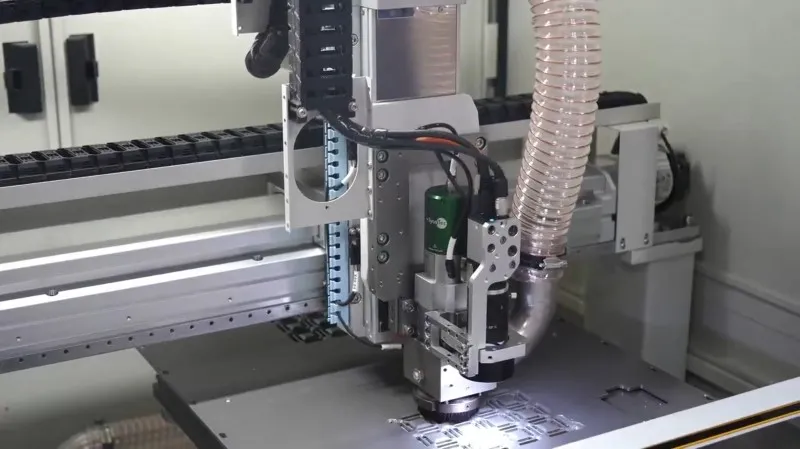
The technical characteristics of automotive-grade depaneling equipment differ substantially from general-purpose alternatives. Understanding these distinctions assists factories in evaluating equipment investments appropriately.High-rigidity mechanical platforms form the foundation of automotive-capable depaneling systems. The machine structure must minimize deflection under cutting loads, requiring engineering approaches including precision-ground spindle mounting surfaces, low-vibration spindle designs, and rigid gantry constructions that resist dynamic loading effects during acceleration and deceleration.
Advanced motion control systems incorporating linear motor drives or high-precision ball screw mechanisms deliver the positional accuracy automotive applications demand. These systems typically incorporate closed-loop feedback with resolution of 0.001mm or finer, enabling the control authority necessary for achieving ±0.03mm tolerances under production conditions.
Thermal compensation algorithms represent a critical differentiator. By monitoring temperature at multiple points within the machine structure and correlating these readings against previously characterized thermal expansion behavior, sophisticated depaneling systems can predictively adjust axis positions to maintain accuracy despite environmental temperature fluctuations. This capability proves essential for factories operating in facilities without precise environmental control.
Vision-guided alignment systems enable precise registration between the cutting path and actual board features, compensating for panel mounting errors and inherent manufacturing variations in panel dimensions. These systems typically employ high-resolution cameras with sub-pixel processing algorithms to achieve alignment accuracy sufficient for automotive applications.
Spindle technology choices significantly influence achievable accuracy and edge quality. High-frequency brushless DC spindles operating at 60,000 RPM or higher deliver the smooth rotational characteristics that minimize subsurface damage. Variable speed control enables parameter optimization for different board materials and thicknesses encountered across diverse automotive product families.
Strategic Approaches for Factories Transitioning to Automotive Quality Standards
For manufacturing facilities previously serving consumer electronics markets and now pursuing automotive opportunities, the depaneling accuracy challenge represents both a significant obstacle and a differentiation opportunity. A structured approach to addressing these requirements positions factories competitively for automotive business.
Equipment capability assessment provides the essential starting point. Factories should conduct thorough evaluations of existing depaneling equipment against automotive requirements, including extended run testing under production conditions rather than brief demonstration periods. This assessment frequently reveals capability gaps that require either equipment upgrading or replacement.
Process characterization enables factories to understand their capability baseline and identify optimization opportunities. By systematically measuring depaneling outcomes across varying production parameters, factories can develop optimized processing protocols that maximize equipment capability within practical production constraints.
Supplier partnership approaches yield advantages over transactional equipment procurement. Equipment manufacturers with extensive automotive experience—including application engineering support, process validation assistance, and ongoing technical collaboration—provide value beyond the equipment itself. This support proves particularly valuable during initial automotive qualification runs when process parameters require iterative refinement.
Documentation practices directly influence qualification success. Automotive customers require comprehensive process capability documentation, including statistical process control records, equipment maintenance histories, and process validation evidence. Establishing disciplined documentation practices before automotive customers request them prevents scramble reactions during customer audits.
Long-term Operational Considerations for Sustaining Accuracy Performance
Achieving automotive-grade depaneling accuracy during initial qualification represents only the beginning of sustained performance requirements. Long-term operational practices determine whether factories maintain their capability positioning or gradually drift away from required standards.
Preventive maintenance programs tailored to automotive accuracy requirements provide essential support for sustained performance. The maintenance intervals and procedures that suffice for general consumer electronics production frequently prove inadequate for maintaining automotive accuracy standards. This includes spindle balance verification, axis alignment confirmation, and thermal system calibration at frequencies appropriate to equipment usage intensity.
Environmental control considerations deserve attention beyond the equipment itself. While advanced depaneling systems incorporate thermal compensation capabilities, the effectiveness of these features depends on understanding the environmental conditions they were characterized against. Facilities experiencing significant environmental variations should either invest in climate control or ensure compensation algorithms account for anticipated operating ranges.
Operator training programs that emphasize the critical nature of depaneling accuracy in automotive contexts help maintain attention to detail during routine operations. The connection between seemingly minor deviations and potential field failures provides meaningful context that general electronics training typically omits.
Incoming material verification becomes increasingly important as automotive specifications propagate through supply chains. Panel manufacturing variations—including dimensional inconsistencies and internal stress states—interact with depaneling processes in ways that can compromise accuracy if not appropriately controlled. Establishing communication channels with panel suppliers regarding automotive-specific requirements creates feedback loops that benefit both parties.
Making Informed Equipment Decisions for Automotive Production Success
The financial implications of depaneling accuracy extend far beyond equipment acquisition costs. Field failure costs, customer de-selection consequences, and reputation damage from quality incidents frequently dwarf any equipment investment premium. This economic reality should inform procurement decisions rather than purely first-cost considerations.
Factories evaluating equipment options should insist on performance verification under actual production conditions rather than accepting vendor specifications at face value. This includes extended testing with representative board materials, production-volume trials that reveal thermal drift behavior, and edge quality evaluation according to automotive-appropriate inspection standards.
Total cost of ownership analysis incorporating accuracy-related failure costs provides appropriate decision framework. While a general-purpose depaneling router might appear attractive at 40% below an automotive-grade alternative, the calculus changes substantially when considering potential warranty costs, customer penalties, and market access implications of quality performance falling short of automotive expectations.
The selection of equipment manufacturers with demonstrated automotive experience and support infrastructure merits serious consideration. Equipment purchases essentially represent partnership commitments that should extend through the equipment’s productive lifespan—typically a decade or longer for well-maintained industrial equipment. The manufacturers capable of supporting automotive production requirements typically demonstrate this capability through references, certifications, and comprehensive application engineering services.
Seprays has spent three decades developing and refining depaneling solutions specifically addressing the accuracy requirements of demanding applications. Our equipment portfolio includes systems engineered to achieve the positional accuracy, repeatability, and edge quality that automotive electronics manufacturing requires. We welcome technical discussions with factories evaluating their automotive capability positioning.