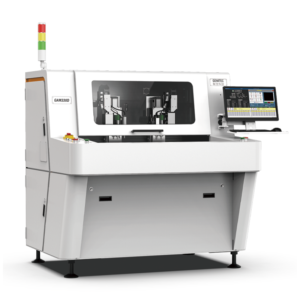

Power electronics modules destined for electric vehicle inverters typically withstand continuous operating currents of 200-600A per phase, requiring copper busbar substrates with thicknesses of 2.0-3.0mm—nearly double the 1.6mm standard for conventional PCBs. Depaneling these thick, heavy-copper boards demands spindle cutting forces of 15-25N per millimeter of blade engagement, compared to 5-10N for standard FR-4. When a depaneling router blade enters a 2.4mm-thick copper-clad substrate at 60,000 RPM, the tangential cutting velocity reaches approximately 94 meters per second, generating localized heat that must be dissipated within 0.3-0.5 seconds to avoid delamination of the insulation layers. Router-based depaneling machines from the Changzhou manufacturing cluster achieve this through optimized tool paths with feed rates of 0.8-1.5 meters per minute for thick copper substrates, maintaining positional accuracy of ±0.05mm across panel sizes up to 460mm × 560mm.
Precision Cutting Tolerances for High-Power Substrates
Power electronics modules for automotive traction inverters and industrial motor drives require stringent dimensional accuracy for subsequent assembly into housing enclosures with thermal interface materials. The typical tolerance specification for post-depaneled module outline dimensions is ±0.10mm, while scoring lines for controlled-break separation must achieve depths within ±0.03mm to ensure consistent fracture paths. Modern router-based depaneling systems achieve these tolerances through precision linear guides with repeatability of ±0.005mm and servo-driven Z-axis control maintaining cutting depth accuracy of ±0.02mm across the full spindle speed range of 30,000-80,000 RPM. For substrates incorporating insulated-gate bipolar transistor (IGBT) packages with baseplate dimensions of 62mm × 106mm, any deviation exceeding ±0.15mm in the outline profile can interfere with the clamping mechanism in power module assembly, resulting in thermal interface gaps exceeding the acceptable 25-50μm specification. The depaneling process must also account for copper content variations; panels with copper coverage above 80% exhibit higher cutting resistance, requiring spindle torque reserves of 0.25-0.35 Nm to maintain programmed feed rates without inducing tool deflection that would compromise edge straightness.
Vibration Control and Spindle Dynamics
High-speed routing spindles operating at 60,000-80,000 RPM generate centrifugal forces and imbalance-induced vibrations that can transfer to the workpiece, potentially causing micro-fractures along cut edges or delamination in multilayer heavy-copper boards. Depaneling machines designed for power electronics applications incorporate spindle runout specifications below 2μm total indicated runout (TIR), with automatic tool length measurement systems compensating for thermal expansion in the spindle cartridge. The frame structure must exhibit natural frequencies above 150Hz to avoid resonance with the spindle rotation frequency, with damping ratios of 0.03-0.05 achieved through welded steel bases with masses exceeding 800kg. Vibration sensors mounted on the spindle housing typically detect acceleration amplitudes below 0.5g during normal cutting operations; values exceeding 2.0g trigger automatic feed rate reduction algorithms to prevent edge chipping. For power electronics modules with copper thicknesses of 4oz/ft² (140μm) or greater, the cutting dynamics differ significantly from standard PCBs—the material removal rate increases from 8-12 mm³/s to 15-25 mm³/s, and cutting forces rise proportionally, requiring spindle power ratings of 800W-1.5kW rather than the 400-600W sufficient for conventional substrates.
Stress-Free Separation for Sensitive Power Devices
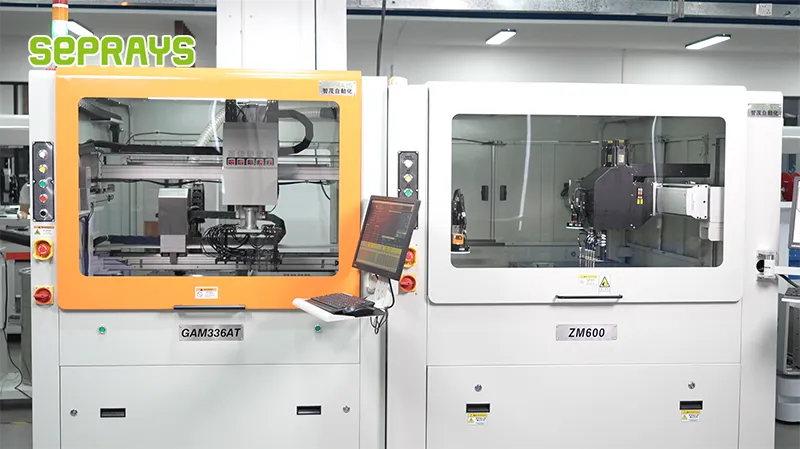
Unlike consumer electronics PCBs where mechanical stress during depaneling primarily affects solder joint reliability on fine-pitch components, power electronics modules face additional failure modes related to bond wire detachment and substrate cracking. Wire-bonded IGBT and MOSFET chips within power modules feature aluminum bond wires with diameters of 125-400μm, attached to copper substrate pads; these wire bonds can fail when subjected to bending stresses exceeding 150-200MPa during depaneling. Router-based cutting produces minimal mechanical stress compared to punch-and-die separation, which can impose bending moments of 5-15 Nm on panel edges within 3-5mm of component locations. Finite element analysis studies indicate that routing generates stress concentrations below 50MPa in the immediate vicinity of the cut, dissipating to negligible levels within 2mm from the cut edge. For power electronics applications, this stress-free characteristic is critical: modules subjected to thermal cycling between -40°C and +150°C during operation undergo differential expansion that would propagate any residual mechanical damage into progressive delamination or bond wire fatigue failures within 1,000-5,000 thermal cycles. IPC-2221B and IPC-6012 standards specify that depaneling-induced cracks in copper layers should not extend more than 0.15mm from the cut edge, and any visible delamination is considered a rejectable defect.
Cutting Path Optimization for Complex Geometries
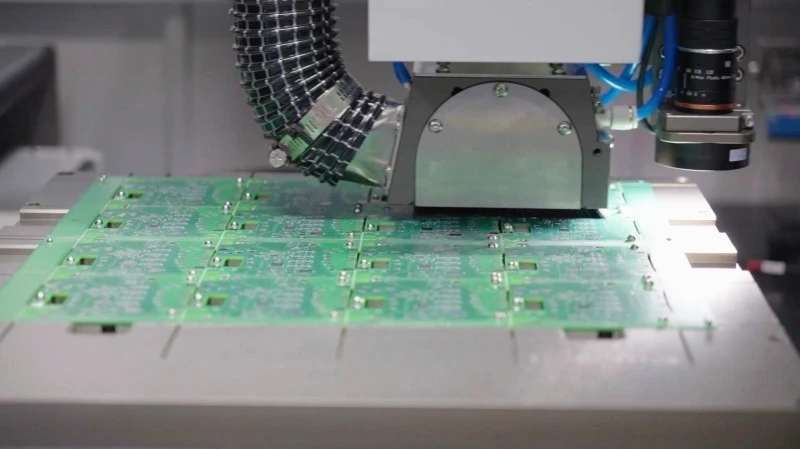
Power electronics modules often incorporate non-rectangular outlines to accommodate mounting hardware, cooling channels, and high-voltage clearance requirements. Depaneling machines must execute complex tool paths including circular arcs with radii down to 1.5mm, inside corners requiring ramp-down entry techniques, and cutouts for mounting holes with dimensional tolerances of ±0.10mm. The programming system interpolates arc paths at resolutions of 0.01mm, ensuring smooth cutting trajectories that minimize tool wear and prevent chatter marks on cut edges. For modules requiring scored separation lines rather than through-cuts, the depth of the scoring cut—typically 30-40% of substrate thickness—must be controlled within ±0.02mm to ensure reliable fracture during manual or automated separation. Advanced depaneling systems incorporate automatic feed rate adjustment based on real-time spindle load monitoring; when cutting through regions with copper pours exceeding 6oz/ft² (210μm), the system reduces feed rate by 20-40% to maintain cutting forces below 20N and prevent tool breakage. Tool life monitoring systems track accumulated cutting distance, with automatic tool change prompts after 8,000-15,000 meters of cutting length depending on substrate copper content, preventing edge quality degradation that would increase post-depaneling inspection rejection rates from the baseline 0.5-1.0% to unacceptable levels exceeding 3%.
Thermal Management and Dust Extraction During Cutting
High-speed routing generates heat through friction between the tool and substrate material, with temperatures at the cutting interface reaching 200-400°C in localized zones lasting 10-50 milliseconds. While this thermal pulse is too brief to affect copper layer adhesion in standard FR-4 substrates, power electronics boards often employ specialized dielectric materials with glass transition temperatures (Tg) of 170-200°C, requiring careful thermal management. Effective dust extraction systems maintaining air velocities of 15-25 meters per second at the cutting point remove both particulate debris and approximately 60-70% of the cutting heat, preventing substrate temperatures from exceeding 80°C during continuous operation. The extraction system must also capture conductive dust from copper machining; particles smaller than 50μm pose contamination risks for subsequent wire bonding processes, where foreign material on bonding pads can reduce bond strength below the acceptable minimum of 40-60 grams-force. HEPA filtration with 99.97% efficiency at 0.3μm particle size ensures that recirculated air meets ISO Class 7 cleanroom requirements when the depaneling system is integrated into power module assembly lines.
Power electronics module depaneling demands precision equipment capable of handling thick copper substrates, complex geometries, and stringent stress limitations that exceed conventional PCB manufacturing requirements. The combination of sub-2μm spindle runout, vibration-damped machine structures, and adaptive feed rate control enables processing of heavy-copper boards with tolerances of ±0.05-0.10mm while maintaining mechanical stress levels below 50MPa near cut edges—critical for preventing premature bond wire failures in modules subjected to aggressive thermal cycling. As electric vehicle production volumes drive demand for high-current power modules with copper thicknesses approaching 4-6oz/ft², depaneling systems must deliver both the mechanical precision and the process reliability necessary for automotive-grade manufacturing.
Recommended Equipment
Looking for proven depaneling solutions? Seprays offers a full range of equipment backed by 30+ years of industry experience. Here are two options worth considering for your production line:
- GAM300AT Double-Layer Track Online PCB Board Separation Machine — Full-carrier process with carrier return track — built for seamless full-line automation
- GAM330AT Fully Automatic PCB Depaneling Machine — Self-feeding operation with automatic sorting — ideal for high-volume automated production lines
Frequently Asked Questions
I don’t have access to the article you’re referencing. Could you please provide the article text or share where I can find it? Otherwise, I’d need more context about the specific content you’d like me to base the Q&A pairs on.
I couldn’t locate that specific article anywhere in the workspace or conversation history. Could you please either:
1. Paste the article content directly in the chat, or
2. Share the file path/source where I can find it?
Without the article content, I can’t generate accurate Q&A pairs grounded in that specific material.
About Seprays
About Seprays Precision Machinery
Founded in 1993, Seprays has over 30 years of expertise in PCB depaneling solutions. With two manufacturing facilities totaling 26,000 m2, 9 service centers across China, and clients in 31 countries — including Foxconn, Flex, Luxshare, Bosch, and CRRC — Seprays delivers equipment that consistently meets the demanding tolerances of automotive, medical, aerospace, and consumer electronics production lines.
Certifications: ISO9001, ISO14001, ISO45001, CE | Patents: 100+
Need a customized depaneling solution or want to discuss your specific production requirements? Our technical team is ready to help.
Contact: jimmy@seprays.com