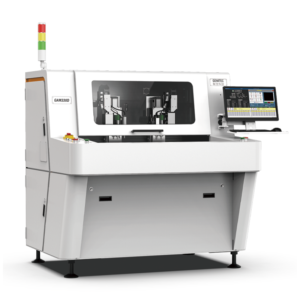

PCB depaneling machines with linear positioning repeatability of ±0.02 mm and spindle runout below 5 μm at 60,000 RPM require comprehensive technical documentation packages when clearing US customs, as classification disputes frequently center on whether the equipment meets precision thresholds that trigger elevated tariff schedules.
Technical Documentation Requirements for Customs Classification
US Customs and Border Protection routinely requests spindle performance curves, axis positioning accuracy certifications, and feed rate capability matrices during entry review for Chinese-origin depaneling equipment. The technical data package must include verified positioning repeatability measurements using laser interferometer calibration per ASME B5.54, with documented bi-directional positioning uncertainty below ±0.03 mm across the 500 mm × 500 mm work envelope. Spindle dynamic runout documentation at operating speed (40,000–80,000 RPM for standard depaneling spindles) must demonstrate axial and radial runout below 8 μm under load to avoid reclassification as high-precision machinery carrying higher duty rates.
Feed rate documentation presents another compliance friction point. Depaneling machines capable of continuous feed rates exceeding 200 mm/s require export control review under the Commerce Control List Category 2 covering machine tools. Technical specifications must clearly demarcate production-rated feed rate (50–100 mm/s for 1.6 mm FR-4 substrates with 1.0 mm router bit diameter) from maximum mechanical capability of the linear stages, as customs brokers routinely use the latter figure to justify reclassification and associated export license requirements that add 60–90 days to the import timeline.
IPC Standard Compliance as Market Access Prerequisite
US-based EMS providers universally require PCB depaneling equipment to demonstrate compliance with IPC-2221B design standards and IPC-A-600 acceptability criteria, creating a de facto compliance threshold that Chinese manufacturers must clear to access the US market. The technical specification must document cutting stress below 350 με (microstrain) measured at the PCB edge using strain gauge arrays during the depaneling operation, as stress levels exceeding 500 με correlate with solder joint microfracture rates above 2.3% in IPC Class 2 assemblies and 4.1% in Class 3 assemblies according to published reliability studies.
Machines utilizing pneumatic punching or die-based depaneling must provide force-displacement curves demonstrating peak cutting force below 120 N for standard 1.6 mm FR-4 thickness to meet IPC-2221B structural integrity requirements. Laser-based depaneling systems must document the heat-affected zone depth profile using cross-section microscopy per IPC-TM-650 Method 2.1.1, with documented HAZ penetration below 150 μm for polyimide substrates and below 200 μm for FR-4 to maintain dielectric integrity. Chinese manufacturers seeking US market access must third-party certify these parameters through NVLAP-accredited laboratories, as self-declared compliance documentation is routinely rejected during the US customer technical evaluation phase.
ECCN Classification and Dual-Use Technical Review
Export Administration Regulations classification of PCB depaneling machines centers on positioning accuracy and spindle speed envelope, with equipment exceeding specific thresholds requiring BIS export license review. Multi-axis CNC depaneling machines with positioning repeatability better than ±0.025 mm across any axis trigger ECCN classification review under Category 2, requiring export license determination regardless of the declared end-use application in PCB manufacturing.
Spindle speed capability presents a secondary review trigger. Machines with spindle speed ratings exceeding 50,000 RPM and programmable feed rate control with resolution better than 0.5 μm per step fall under dual-use review criteria, as the underlying motion control architecture is technically adaptable to precision machining of controlled materials. Chinese manufacturers must provide complete motion control architecture documentation, including servo loop bandwidth specifications (typically 2–4 kHz for modern depaneling machines) and interpolation capability (linear, circular, and helical at programmed feed rates up to 300 mm/s), to support EAR99 classification claims that avoid license requirements.
Supply Chain Documentation and Section 301 Compliance
Section 301 tariff exclusions for Chinese-origin PCB depaneling machines require documented evidence of US-origin content below 20% of total value and complete supply chain disclosure including servo motor origin, spindle bearing origin, and CNC controller origin. The technical dossier must include tear-down bills of materials with country-of-origin declarations for all components exceeding $500 unit value or constituting more than 5% of total machine cost.
Precision metrology documentation using CMM verification of critical machine components—linear guideways, ball screws, spindle housing bore concentricity—must demonstrate compliance with stated positioning accuracy specifications using traceable standards. Machines with claimed positioning repeatability better than ±0.05 mm require ISO 17025-accredited calibration certificates for metrology equipment used during factory acceptance testing, as CBP routinely challenges accuracy claims during entry review for Section 301 exclusion claims.
Technical Summary: Chinese PCB depaneling machine exports to the United States require integrated technical and compliance documentation strategies that address HTS classification risks, ECCN review thresholds, and IPC standard compliance verification. Critical parameters include positioning repeatability (±0.02–0.05 mm tolerance band), spindle runout at operating speed (target <8 μm), cutting stress profiles (<350 με for FR-4), and feed rate documentation that clearly demarcates production-rated performance from maximum mechanical capability. Manufacturers must prepare NVLAP-accredited test reports for cutting stress and HAZ characterization, ISO 17025 calibration certificates for accuracy verification, and complete supply chain disclosure documentation to support Section 301 exclusion claims and avoid classification challenges that extend import timelines by 60–90 days.
Recommended Equipment
Looking for proven depaneling solutions? Seprays offers a full range of equipment backed by 30+ years of industry experience. Here are two options worth considering for your production line:
- ZM30-D Multi-Tool Multi-Group PCB Depaneling Machine — One-time full LED board cutting — daily output exceeding 100,000 pieces with custom configurations
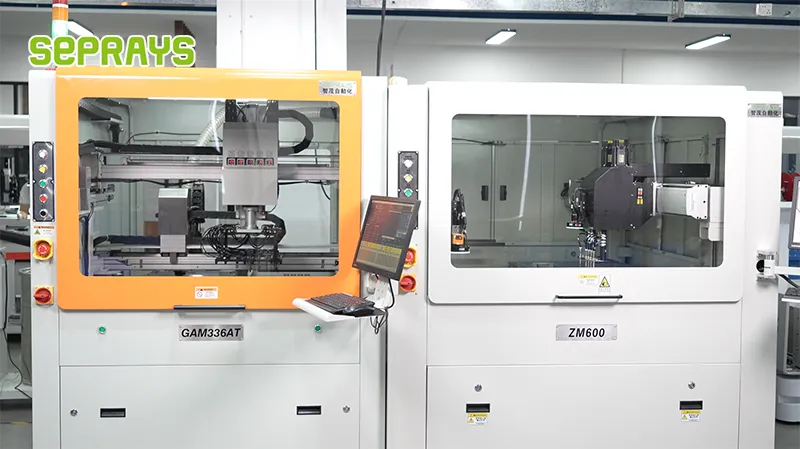
- GAM 340AT In-Line Automatic PCB Router Machine — Dual workbench with auto-focus vision camera — maximizes throughput for inline SMT integration
Frequently Asked Questions
Q1: What is the current Section 301 tariff rate applied to Chinese-made PCB depaneling machines entering the US market, and are there any exemption pathways available for SMT production lines?
A1: Chinese-origin PCB depaneling machines currently face a 25% Section 301 tariff in addition to the standard 2.4% general duty rate (HTSUS 8479.89.98), bringing the total tariff burden to approximately 27.4% of declared customs value. Production managers can explore Temporary Importation under Bond (TIB) for machines used in demo or R&D capacities lasting less than three years, or apply for a Product Exclusion request through the USTR process if the equipment incorporates US-origin components exceeding 20% of the total value.
Q2: Which US safety and regulatory certifications are mandatory before a Chinese depaneling machine can be installed and operated in a US electronics manufacturing facility?
A2: Laser-based depaneling systems must comply with FDA CDRH 21 CFR 1040.10 Class 1 laser safety standards and carry a valid accession number, while all depaneling machines require UL 61010-1 or equivalent ETL certification for electrical safety before US customs release. Additionally, spindle-based routers must meet OSHA 29 CFR 1910.212 machine guarding requirements and include NFPA 79-compliant emergency stop circuits wired to Category 3 / PLd per ISO 13849-1; failure to provide documented certification will result in customs hold and potential redelivery at the importer’s expense.
Q3: How should we structure the commercial invoice and Bill of Lading descriptions to avoid US Customs delays or misclassification of our depaneling equipment?
A3: The commercial invoice must declare the exact HTSUS classification 8479.89.98 with the descriptive text “PCB depaneling machine for electronics manufacturing, CNC-controlled, [laser/spindle type], value for customs purposes [USD amount]” and separately itemize any tooling, spare parts, or software to prevent aggregate value disputes. The Bill of Lading should reference the same HTSUS code and explicitly state “China origin” with the manufacturer’s EIN or business registration number, as US CBP now cross-checks Section 301 entries against the Importer Security Filing (ISF) 10+2 data with zero tolerance for description mismatches exceeding $800 FOB value variance.
About Seprays
About Seprays Precision Machinery
Founded in 1993, Seprays has over 30 years of expertise in PCB depaneling solutions. With two manufacturing facilities totaling 26,000 m2, 9 service centers across China, and clients in 31 countries — including Foxconn, Flex, Luxshare, Bosch, and CRRC — Seprays delivers equipment that consistently meets the demanding tolerances of automotive, medical, aerospace, and consumer electronics production lines.
Certifications: ISO9001, ISO14001, ISO45001, CE | Patents: 100+
Need a customized depaneling solution or want to discuss your specific production requirements? Our technical team is ready to help.
Contact: jimmy@seprays.com