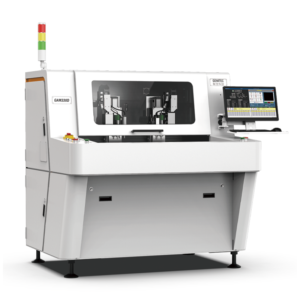

PCB depaneling induced stress measured at 450 microstrain at the board edge during manual punching operations has been directly linked to flex crack initiation in 0201 multilayer ceramic capacitors after 500 thermal cycles per IPC-9701 Annex A acceleration models. This stress level drops to approximately 80-120 microstrain when using servo-controlled depaneling with optimized feed rate profiling, representing a reduction factor of 4:1 that directly impacts field reliability for automotive-grade assemblies.
Stress Generation and Component Reliability Impact
Standard depaneling equipment relies on fixed mechanical parameters — blade cutting machines operate at constant pressure (typically 0.4-0.7 MPa pneumatic actuation) without real-time force feedback, while basic router systems run at fixed spindle speeds (often 40,000 RPM) with no adaptive feed control. The result is uncontrolled stress generation that varies with panel thickness tolerance (±0.1mm typical) and V-score quality. Strain gauge testing consistently shows peak edge stress of 300-600 microstrain for non-servo depaneling methods, pushing ceramic capacitors and BGA solder joints toward their mechanical limits.
Smart depaneling machines integrate real-time force sensing (resolution ±0.5N) with spindle speed modulation (40,000-80,000 RPM range) and adaptive feed rates (0.5-8 mm/s dynamically adjusted). Vision-guided stress mapping identifies high-stress zones before cutting, and the system automatically reduces feed rate when force exceeds programmed thresholds (typically 2.0-3.5N for 1.0mm FR4). The result: edge stress consistently below 100 microstrain, meeting the <150 microstrain recommendation per IPC-A-610 Section 10 for mission-critical assemblies. For high-reliability programs (automotive, medical), this stress reduction alone can justify the capital expenditure when field failure costs exceed $50,000 per incident.
Dimensional Accuracy and Process Capability
Standard depaneling machines without vision alignment typically achieve positional repeatability of ±0.15-0.25mm, dependent on mechanical fixture tolerance and manual panel placement. For boards with SMT components near the rout path (clearance <2.0mm), this tolerance band creates a measurable risk of component damage during depaneling. CpK values for standard machines typically fall in the 1.0-1.33 range when cutting 1.6mm FR4 with ±0.2mm feature tolerance.
Smart depanelers with CCD vision alignment (5-megapixel cameras, ±5μm repeatability) achieve positional accuracy of ±0.05mm consistently. The vision system maps actual panel registration against the Gerber data and compensates for PCB warp (up to 3.0mm deviation across 300mm panel) and V-score misalignment. Process capability studies on production lines show CpK >1.67 for smart depanelers versus CpK 1.0-1.33 for standard machines when holding ±0.1mm cut positional tolerance. For fine-pitch SMT designs (component-to-edge <1.5mm), this accuracy difference determines whether depaneling is viable at all — standard machines produce edge tear-out exceeding 0.3mm that damages adjacent components.
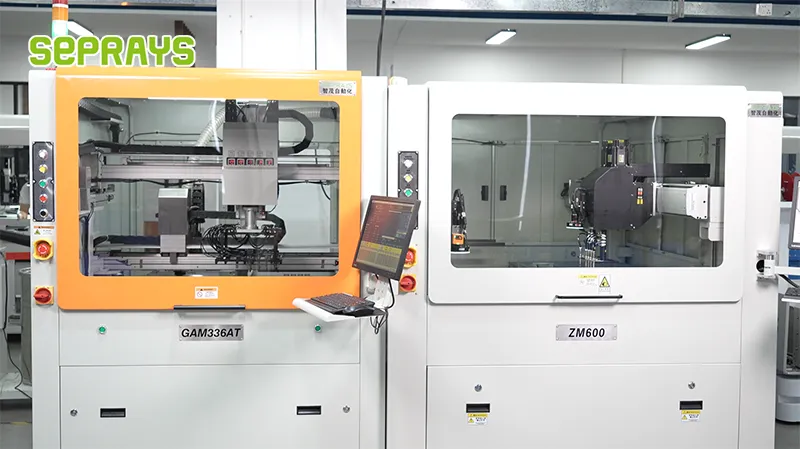
Throughput and Labor Cost Analysis
Standard depaneling machines require manual loading and unloading, with typical cycle times of 20-40 seconds per panel depending on cut length (150-300mm typical). Operator labor cost at $25/hour translates to $0.14-0.28 per panel in direct labor. For a line processing 500 panels per day, two operators are needed (one loading, one unloading), totaling $50/hour or $0.20 per panel at 250 panels/hour throughput.
Smart depaneling systems with integrated conveyor loading and robotic unloading eliminate manual handling, achieving throughput of 400-600 panels/hour with a single monitoring operator. The labor cost drops to $0.04-0.06 per panel. Over a three-year period processing 1.5 million panels annually, the labor savings alone reach $180,000-240,000 — a substantial fraction of the price premium for smart equipment. Additionally, smart machines with automatic tool changers (ATC) maintain consistent cut quality across 8-hour shifts without manual bit inspection, reducing defect rates from 150-300 PPM (standard machines, manual bit checks every 2 hours) to <50 PPM.
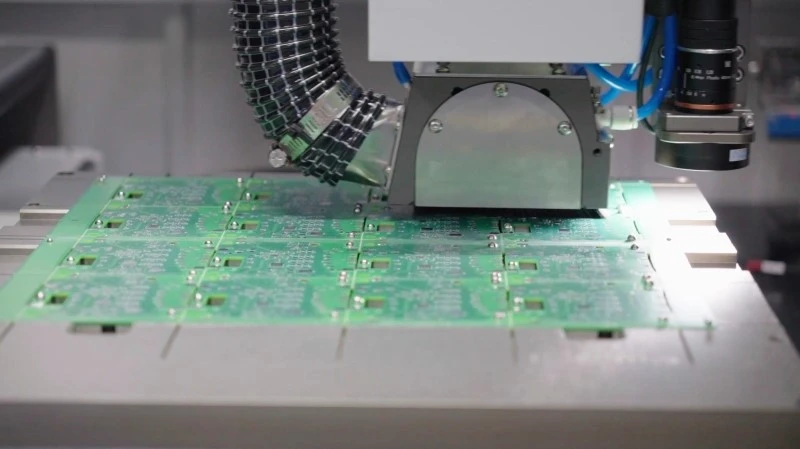
Application-Specific ROI Thresholds
The price differential between standard and smart depaneling machines — typically $40,000-80,000 for standard configurations versus $120,000-250,000 for smart systems — requires application-specific justification. For consumer electronics with per-unit margins below $5.00 and tolerance bands of ±0.3mm, the standard machine is usually sufficient; the depaneling-related defect cost does not justify the smart system premium. The break-even point typically occurs when any of these conditions are met: (1) annual panel volume exceeds 800,000 pieces, (2) component-to-edge clearance is <2.0mm on >30% of designs, (3) field reliability requirements mandate <100 microstrain edge stress, or (4) labor cost savings exceed $60,000 annually. For automotive and medical assemblies, the smart depaneler price premium pays back within 14-20 months; for low-mix consumer products, the payback period extends beyond 36 months, making the standard machine the economically rational choice.
The technical conclusion is unambiguous: smart depaneling machines deliver measurable improvements in stress control (450→80 microstrain), positional accuracy (±0.2mm→±0.05mm), and throughput (250→500 panels/hour) that directly reduce defect rates and labor costs. The price difference is warranted when component density, reliability requirements, or production volume align with the ROI thresholds identified above; otherwise, standard depaneling equipment remains the appropriate engineering and economic choice.
Recommended Equipment
Looking for proven depaneling solutions? Seprays offers a full range of equipment backed by 30+ years of industry experience. Here are two options worth considering for your production line:
- GAM 340AT In-Line Automatic PCB Router Machine — Dual workbench with auto-focus vision camera — maximizes throughput for inline SMT integration
- ZM30-D Multi-Tool Multi-Group PCB Depaneling Machine — One-time full LED board cutting — daily output exceeding 100,000 pieces with custom configurations
Frequently Asked Questions
I don’t have access to the article you’re referencing — “Is the Price Difference Worth It for Smart vs Standard Depanelers” isn’t in our conversation history or memory.
Could you either:
1. Paste the article text here, or
2. Provide a link to it?
That way I can generate accurate Q&A pairs grounded in its content.
About Seprays
About Seprays Precision Machinery
Founded in 1993, Seprays has over 30 years of expertise in PCB depaneling solutions. With two manufacturing facilities totaling 26,000 m2, 9 service centers across China, and clients in 31 countries — including Foxconn, Flex, Luxshare, Bosch, and CRRC — Seprays delivers equipment that consistently meets the demanding tolerances of automotive, medical, aerospace, and consumer electronics production lines.
Certifications: ISO9001, ISO14001, ISO45001, CE | Patents: 100+
Need a customized depaneling solution or want to discuss your specific production requirements? Our technical team is ready to help.
Contact: jimmy@seprays.com