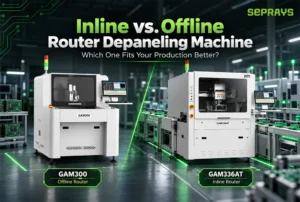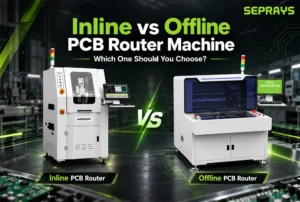

Choosing between an inline and offline router depaneling machine mainly depends on your production flow, automation level, product change frequency, and required cycle time.
The following comparison focuses on the factors that matter most in actual production.
1. Start With How the Depaneling Process Fits Into Your Production
The first question is not which machine has higher specifications, but whether PCB depaneling operates as an independent workstation or as part of a continuous automated line.
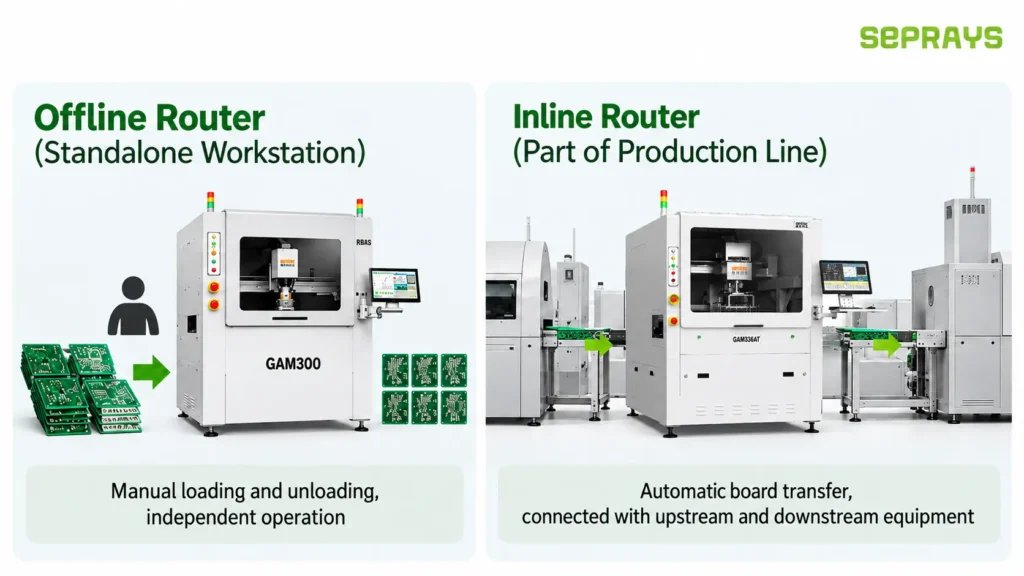
An offline router depaneling machine normally works as a standalone station. Operators can load PCB panels, change fixtures, switch programs, and remove finished boards independently.
An inline router depaneling machine is designed to connect with upstream and downstream equipment so PCB panels can move through the depaneling process with less manual handling.
In simple terms, an offline router works more like an independent workstation, while an inline router becomes part of the production line itself.
2. Inline vs. Offline Router Depaneling Machine: Application Comparison
| Comparison | Inline Router Depaneling Machine | Offline Router Depaneling Machine |
|---|---|---|
| Production mode | Continuous automated production | Standalone or batch production |
| Loading and unloading | Automatic | Usually manual |
| Product changeover | Better for stable, repeated production | Better for frequent model changes |
| Operator involvement | Lower | Higher |
| SMT line integration | Strong | Limited |
| High-mix production | Possible | More suitable |
| Continuous mass production | More suitable | Depends more on operator cycle |
| Main advantage | Automation and stable production flow | Flexibility and easier product changeover |
If your factory changes PCB models frequently, an offline machine usually makes fixture and program changes easier. If one product runs continuously and the depaneling process must follow the takt time of the complete line, an inline system has a stronger advantage.
In short, inline machines prioritize production continuity, while offline machines prioritize production flexibility.
3. Cycle Time Matters More for Inline Production
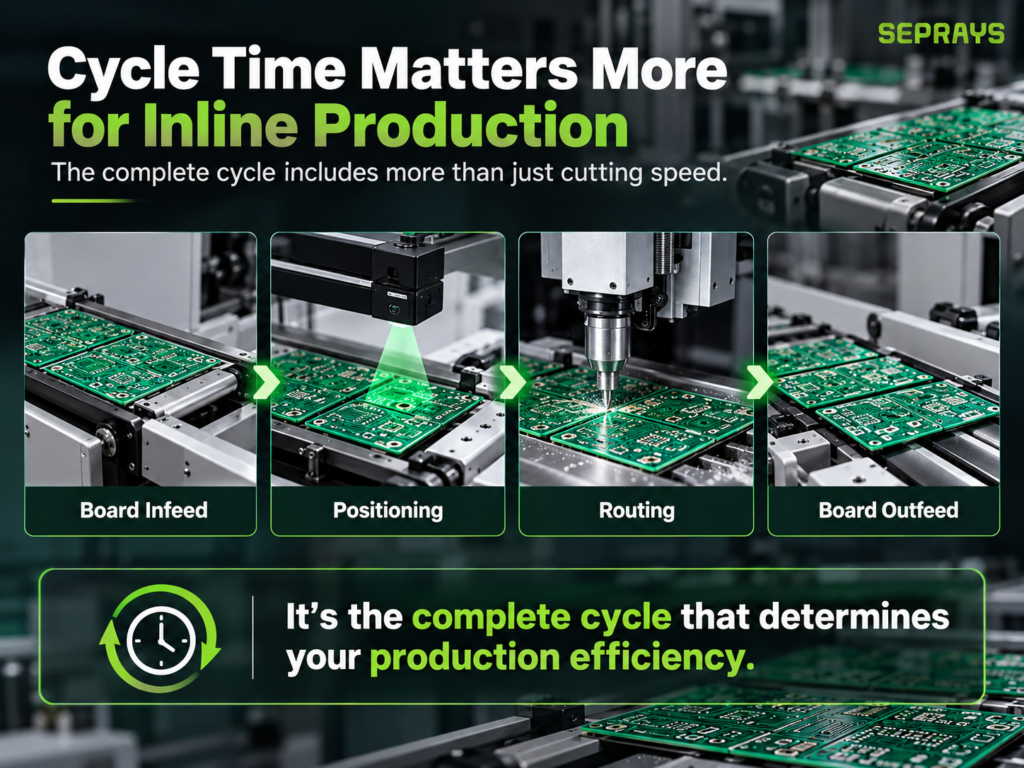
For an inline router depaneling machine, cutting speed alone does not determine production efficiency.
The complete cycle normally includes:
Vision alignment, barcode reading, fixture movement, or data communication may also add to the total cycle time.
This means the most useful question is not simply “How fast can the router cut?” but “Can the complete machine cycle keep up with the rest of the production line?”
If the router is slower than upstream equipment, PCB panels may begin to queue. If downstream equipment is slower, additional router speed may provide little practical benefit.
4. Automation and Factory Integration Can Influence the Choice
If PCB depaneling only needs to operate as an independent process, an offline machine may already provide everything the factory needs.
However, when production requires automatic board transfer, barcode identification, traceability, MES communication, or interaction with other machines, an inline system usually provides a more suitable platform.
TheIPC-2591 Connected Factory Exchange (CFX) standard establishes requirements for information exchange between electronics manufacturing processes and factory systems, including automated, semi-automated, and manual processes. It also supports applications such as MES control, production tracking, quality management, and traceability.
Traceability can also become important in industries with higher reliability requirements. IPC-1782 establishes manufacturing and supply-chain traceability requirements for electronic products and applies to printed board assembly manufacturing across markets including automotive, medical, aerospace, telecom, and consumer electronics.
5. A Simple Way to Choose
An inline router depaneling machine is generally the better direction when your priorities are:
- continuous automated production;
- automatic PCB transfer;
- lower operator involvement;
- stable line takt time;
- SMT, MES, or traceability integration.
An offline router depaneling machine is generally more practical when your priorities are:
- frequent PCB model changes;
- high-mix production;
- flexible scheduling;
- easy fixture changeover;
- standalone or engineering production.
If your production combines high output with frequent product changes, the decision should not be based on volume alone. Product change frequency, target cycle time, labor requirements, and automation level should be evaluated together.
Conclusion
There is no universal winner between inline and offline router depaneling machines. Inline systems are better suited to continuous automated production, while offline systems are better suited to flexible and high-mix manufacturing.
The best choice is the one that matches how your PCBs actually move through production today while leaving enough flexibility for future automation requirements.