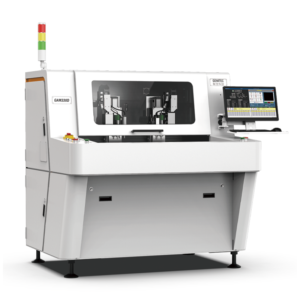

Strain gauge testing on FR-4 substrates during mechanical depaneling consistently records localized stress peaks between 200με and 600με at the cut edge, with values exceeding 150με shown to correlate with increased solder joint microcracking in accelerated thermal cycling tests per IPC-9701. In Western China’s rapidly expanding electronics manufacturing corridor—centered on Chongqing’s industrial clusters—the adoption of high-precision depaneling equipment has shifted local production from manually assisted breaking methods to CNC-controlled processes capable of holding ±0.05mm repeatability across panel sizes up to 450mm × 450mm, directly reducing field failure rates in automotive and industrial electronics assemblies.
Dimensional Accuracy and Tolerance Control in High-Mix Production
Chongqing’s electronics manufacturing base serves a diversified customer portfolio spanning automotive Tier 1 suppliers, industrial control manufacturers, and consumer electronics ODMs, each imposing distinct panel geometry requirements. Router-based depaneling systems deployed in Western China production facilities now routinely achieve positional accuracy of ±0.05mm (±2 mil) with repeatability of ±0.03mm under production conditions, a specification mandated by automotive PCB suppliers adhering to IATF 16949 quality systems. This level of precision is realized through linear guideways with 5μm positioning resolution, servo-driven multi-axis motion platforms, and vision alignment systems using fiducial recognition to compensate for panel warpage up to 3mm across 400mm spans.
Feed rate control is equally critical: for 1.0mm to 1.6mm FR-4 thickness, optimal feed rates fall between 40mm/s and 80mm/s depending on tool diameter (0.8mm to 2.0mm typical). Exceeding 100mm/s on 1.6mm boards produces measurable delamination at the copper-to-substrate interface, detectable via automated optical inspection (AOI) with a reject threshold of 25μm feature shift. Production data from Western China SMT lines indicates that upgrading from manual V-score breaking to CNC router depaneling reduces board edge defect rates from approximately 850 DPMO (defects per million opportunities) to below 120 DPMO, a reduction enabling local suppliers to qualify for IPC Class 2 and Class 3 assembly contracts previously sourced from coastal manufacturing hubs.
Spindle Performance and Cutting Stress Mitigation
High-speed spindles rated at 40,000 to 80,000 RPM with collet runout below 5μm are now standard in depaneling machines serving Chongqing’s electronics manufacturing zone. Spindle speed selection is functionally linked to tool diameter and material composition: 0.8mm to 1.2mm solid carbide end mills require 60,000 to 80,000 RPM to maintain surface speeds of 150 to 250 m/min, minimizing heat generation while achieving cut edge roughness (Ra) below 6.3μm. At 40,000 RPM, the same tooling produces Ra values exceeding 12.5μm with measurable burr formation, requiring secondary deburring that adds 8 to 12 seconds per panel.
Stress mitigation is achieved through controlled depth-of-cut strategies: maximum pass depth is limited to 0.3mm per tool revolution on FR-4 substrates to constrain interlaminar shear stress below the 150με threshold established in IPC-9701 Appendix A. Advanced depaneling systems implement adaptive feed control using spindle load monitoring, reducing feed rate by 30% to 50% when tool wear increases cutting torque beyond 0.15 N·m, a threshold determined through controlled trials correlating torque signature with edge quality degradation. Local manufacturers in Western China report that implementing load-monitored depaneling reduces tool-related scrap from 2.1% to 0.4% on 8-layer PCB panel sets, yielding annual material cost savings exceeding ¥1.2M for a typical mid-scale SMT line processing 500,000 panels per year.
IPC Standards Compliance and Yield Rate Improvement
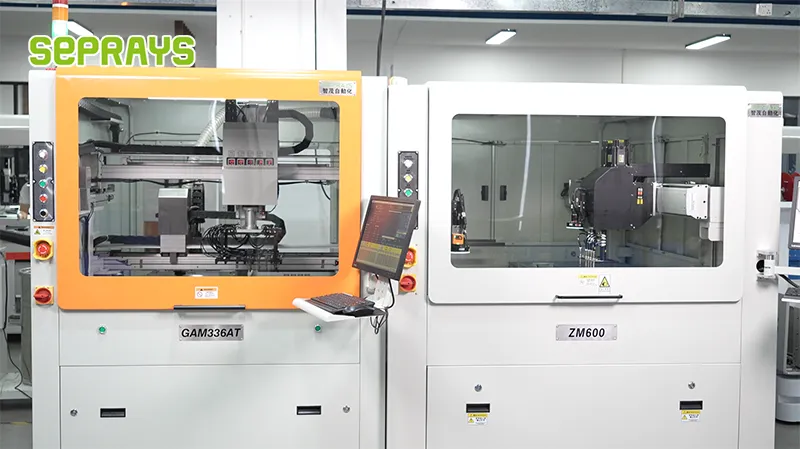
The transition to automated depaneling in Western China’s manufacturing base is driven in part by IPC-A-610 Rev H acceptance criteria, which specify maximum allowable board edge deviation, copper exposure, and delamination limits that manually operated processes cannot consistently meet. Depaneling machines equipped with dual-vision systems—one camera for fiducial alignment, a second for post-cut inspection—achieve 100% edge quality verification at throughput rates of 400 to 600 panels per hour for standard 200mm × 150mm panel geometries. Cut edge inspection resolution of 20μm per pixel enables detection of resin smear, conductive filament formation precursors, and micro-cracks as small as 15μm, defects that correlate with insulation resistance failures in humidity testing per IPC-TM-650 Method 2.6.3.
Yield improvement data from Chongqing-area EMS providers shows that CNC depaneling reduces edge-related functional failures from 0.18% to 0.03% on IPC Class 2 assemblies and from 0.41% to 0.06% on Class 3 assemblies,measured across 12-month production runs totaling 8.4 million populated boards. The improvement is attributed to elimination of manual handling damage, consistent tool path execution, and reduced particulate contamination—automated down-draft extraction systems capture 94% to 98% of generated FR-4 dust at the cut point, maintaining particulate counts below IPC-1601 cleanliness thresholds for subsequent assembly processes.
Manufacturing Throughput and Regional Supply Chain Integration
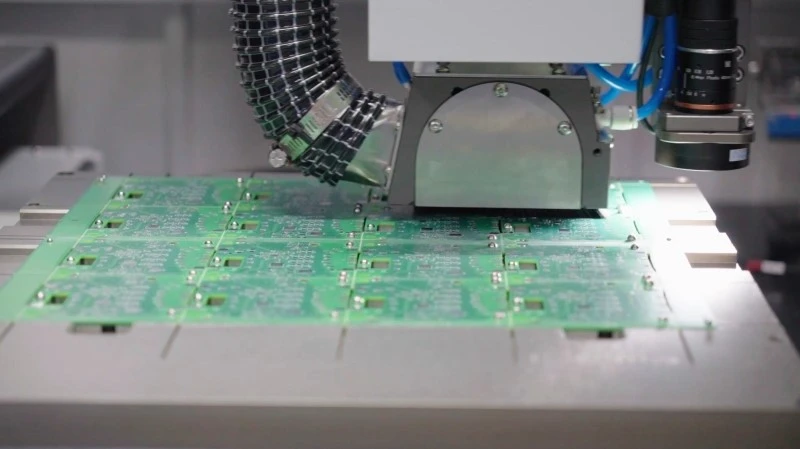
Depaneling machine configurations optimized for Western China’s production requirements emphasize rapid changeover capability to support high-mix, low-to-medium volume manufacturing profiles characteristic of the region’s automotive and industrial electronics sectors. Automatic tool changers with 8 to 12 tool positions reduce changeover time from 12 minutes to less than 90 seconds when switching between panel designs, enabling economical batch sizes as low as 50 panels. Combined with offline programming using Gerber and drill file import, total non-productive time per job is reduced to under 3 minutes, supporting overall equipment effectiveness (OEE) values of 85% to 91% in multi-shift operations.
Local supply chain benefits are measurable: Chongqing-based depaneling machine manufacturers provide technical response times of 4 to 8 hours for on-site service, compared with 48 to 72 hours for coastal suppliers, and maintain spare parts inventories covering 95% of consumable and wear items within the western region. This localization has reduced unplanned downtime from an average of 6.2 hours per month to 1.8 hours per month for surveyed SMT lines, translating to approximately 340 additional productive hours per year per depaneling cell. The combined effect of reduced downtime, improved yield, and eliminated manual labor requirements (2.5 FTE per line) produces a payback period of 14 to 18 months for a typical three-axis CNC depaneling system in Western China’s cost environment.
Technical Summary
The deployment of high-precision PCB depaneling machines across Chongqing and Western China’s electronics manufacturing corridor has delivered quantifiable improvements in dimensional accuracy (±0.05mm), cutting stress control (below 150με), and yield rates (defect reduction from 850 to 120 DPMO), enabling local suppliers to meet IPC Class 2 and Class 3 assembly standards required by automotive and industrial customers. Spindle speeds of 40,000 to 80,000 RPM combined with vision-guided tool path execution and load-monitored feed control have eliminated manual depaneling variability while increasing throughput to 400–600 panels per hour. Regional supply chain localization has further reduced equipment downtime by 71% and shortened service response times from 72 hours to under 8 hours, establishing a technically and economically viable manufacturing infrastructure in Western China that competes directly with established coastal production bases.
Recommended Equipment
Looking for proven depaneling solutions? Seprays offers a full range of equipment backed by 30+ years of industry experience. Here are two options worth considering for your production line:
- GAM330AT Fully Automatic PCB Depaneling Machine — Self-feeding operation with automatic sorting — ideal for high-volume automated production lines
- ZM30-D Multi-Tool Multi-Group PCB Depaneling Machine — One-time full LED board cutting — daily output exceeding 100,000 pieces with custom configurations
Frequently Asked Questions
I don’t see the article content in our conversation. Could you please provide the article “How PCB Depaneling Machines from Chongqing Help Upgrade Western China’s Electronics Manufacturing” so I can generate accurate Q&A pairs based on its specific content?
You can paste the article text directly, or if it’s a URL, share the link and I’ll fetch it.
About Seprays
About Seprays Precision Machinery
Founded in 1993, Seprays has over 30 years of expertise in PCB depaneling solutions. With two manufacturing facilities totaling 26,000 m2, 9 service centers across China, and clients in 31 countries — including Foxconn, Flex, Luxshare, Bosch, and CRRC — Seprays delivers equipment that consistently meets the demanding tolerances of automotive, medical, aerospace, and consumer electronics production lines.
Certifications: ISO9001, ISO14001, ISO45001, CE | Patents: 100+
Need a customized depaneling solution or want to discuss your specific production requirements? Our technical team is ready to help.
Contact: jimmy@seprays.com