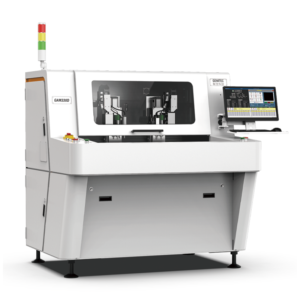

When a 1.6mm thick FR-4 panel routed at 60,000 RPM enters the cutting blade at 8 m/min feed rate, the instantaneous
stress at the entry point can exceed 18 MPa—enough to cause micro-cracks in the solder mask if the blade runout exceeds 0.008mm. This precise challenge defines the boundary between a depaneling machine that meets European and American aerospace-grade assembly standards and one that merely suffices for consumer electronics. Chinese manufacturers have systematically closed this gap over the past decade, driven by export requirements and increasingly stringent quality certifications demanded by overseas customers.
Precision Engineering and Positional Accuracy
The foundational metric for any high-precision depaneling system is positional accuracy, typically measured as the deviation between the programmed cut path and the actual blade track. European automotive electronics manufacturers commonly specify ±0.05mm tolerance on routing paths up to 400mm in length, while aerospace PCB suppliers—governed by AS6081 and IPC-A-600 Class 3 requirements—demand ±0.03mm or tighter. Contemporary Chinese-built machines using closed-loop servo drives with 0.001mm linear encoder resolution routinely achieve ±0.02mm positional accuracy under stable thermal conditions. This represents a threefold improvement over domestic-market machines from 2018, which typically delivered ±0.06mm accuracy.
Thermal compensation remains the primary obstacle to maintaining precision during extended production runs. A spindle bearing heating from 25°C to 45°C during continuous operation can induce 0.04-0.06mm positional drift if uncompensated. Leading Chinese manufacturers now integrate ambient temperature sensors and predictive thermal modeling algorithms that adjust blade compensation in real time, reducing drift to under 0.015mm across a typical 8-hour shift. This approach aligns with IPC-2221 guidelines for thermal management in electronic manufacturing equipment.
Spindle Technology and Cutting Parameters
High-speed spindles in the 40,000-80,000 RPM range define the cutting capability envelope. German and American equipment specifications typically call for spindle runout below 0.005mm (TIR), with radial vibration amplitude under 0.003mm at maximum speed. Chinese spindle manufacturers have responded by adopting high-precision ceramic hybrid bearings and implementing dynamic balancing procedures that achieve TIR runout of 0.004mm—a specification previously exclusive to European suppliers.
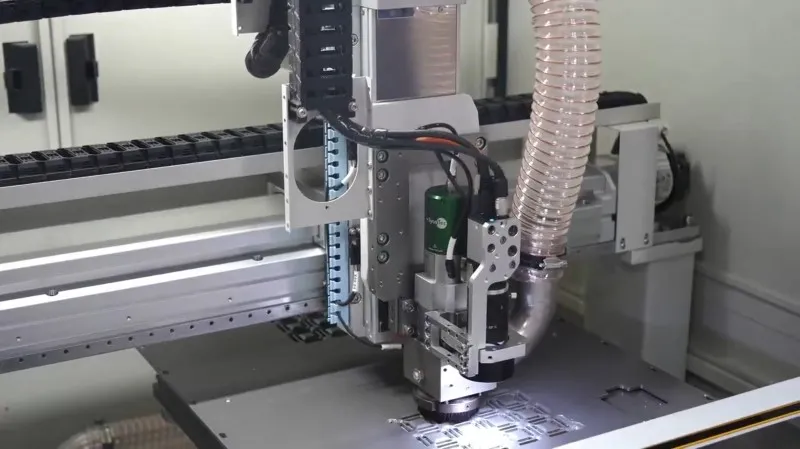
Cutting parameters must balance throughput against board stress. For standard FR-4 boards, recommended feed rates range from 3-12 m/min depending on material thickness and trace density. Thinner boards (0.8-1.0mm) require reduced feeds (3-5 m/min) to minimize breakout and delamination risk. High-Tg materials such as FR-4HR (Tg 170°C) demand 20-30% lower feed rates than standard FR-4 due to their higher hardness. The relationship between feed rate, spindle speed, and resultant cutting stress follows the formula τ = (F × v) / (A × n), where F is feed force, v is feed rate, A is cross-sectional cut area, and n is spindle RPM. Understanding this relationship allows operators to optimize for either speed or board integrity depending on the application.
Stress Reduction and Board Integrity
Excessive cutting stress causes three primary failure modes in sensitive PCBs: copper trace lifting, internal delamination, and solder mask micro-cracking. Copper trace lifting occurs when shear stress at the cut edge exceeds the adhesion strength between copper and substrate—typically 2-4 MPa for electroplated copper on FR-4. Delamination manifests when interlaminar stress exceeds the bond strength between prepreg layers, particularly problematic in multilayer boards with 6 or more layers. Solder mask cracking, while often cosmetic, can compromise long-term reliability in harsh environment applications.
Modern Chinese depaneling systems address stress through multiple mechanisms. Oscillating blade routers with 0.5-2.0mm orbital motion reduce effective cutting force by 40-60% compared to straight routing. Diamond-coated blades with optimized rake angles (-5° to +15°) slice through materials with minimized feed force requirements. Real-time cutting force monitoring via spindle torque sensors enables closed-loop control that automatically adjusts feed rate when stress thresholds are approached. Machines configured for aerospace applications typically maintain peak cutting stress below 12 MPa, providing adequate margin against the 15-20 MPa failure threshold for standard FR-4.
Compliance with International Standards
Meeting European and American market requirements necessitates compliance with multiple overlapping standards. IPC-A-600 defines acceptability criteria for printed boards, including edge quality specifications relevant to depaneling. IPC-2221 establishes design requirements for electronic equipment, including guidance on tolerances and material handling. For automotive applications, IATF 16949 quality management systems mandate process capability indices (Cpk) of 1.67 or higher for critical dimensions—meaning the process variation must fit within six standard deviations of the tolerance band.
CE marking requirements for machinery in the European Union encompass electromagnetic compatibility (EMC), electrical safety, and noise emissions. Chinese manufacturers have responded by implementing EMC filtering to EN 55011 Class B limits, adding safety interlocks with 0.5-second or faster response times, and incorporating acoustic enclosures that reduce operating noise to below 75 dB(A). UL listing for the North American market requires compliance with UL 61010 electrical equipment standards, driving improvements in electrical design and documentation practices.
System Integration and Process Control
High-precision depaneling does not exist in isolation—it requires integration with upstream and downstream manufacturing systems. SMEMA-compliant interface protocols enable communication with reflow ovens, AOI systems, and automated handling equipment. Real-time production data logging supporting SPC (Statistical Process Control) analysis has become a baseline expectation for export equipment. Modern machines generate detailed logs capturing spindle speed, feed rate, cutting force, temperature, and positional data for every individual board processed.
The convergence of precision mechanics, advanced spindle technology, and sophisticated process control has enabled Chinese PCB depaneling equipment to satisfy the demanding requirements of European and American electronics manufacturers. Today’s export-oriented machines routinely deliver ±0.02mm positional accuracy, sub-0.005mm spindle runout, and stress-controlled cutting parameters that meet or exceed specifications established by major automotive and aerospace customers. This capability represents not merely incremental improvement but a fundamental transformation in the competitive positioning of Chinese manufacturing equipment in the global market.
Recommended Equipment
Looking for proven depaneling solutions? Seprays offers a full range of equipment backed by 30+ years of industry experience. Here are two options worth considering for your production line:
- GAM310A Offline Automatic Board Separator — Compact single workbench with CCD visual correction — high precision in a small footprint
- GAM300AT Double-Layer Track Online PCB Board Separation Machine — Full-carrier process with carrier return track — built for seamless full-line automation
Frequently Asked Questions
Q1: What cutting tolerance and positional accuracy can Chinese PCB depaneling machines achieve to meet European automotive electronics standards?
A1: High-precision Chinese depaneling routers achieve cutting tolerances of ±0.05mm with positional repeatability of ±0.02mm using linear motor drives and high-resolution encoders. Spindle runout is controlled to <3μm at 60,000-100,000 RPM to prevent component damage during depaneling of dense automotive PCB assemblies.
Q2: How do Chinese depaneling machine manufacturers demonstrate compliance with IPC-2221B standards required by US customers?
A2: Leading Chinese suppliers provide third-party strain gauge test reports showing cutting stress below 1,000μStrain per IPC-2221B Section 9 requirements. They also supply process capability data with Cpk≥1.33 for critical parameters including tool path accuracy and depaneled edge quality.
Q3: What throughput and changeover capabilities should we expect from Chinese depaneling machines for high-mix European contract manufacturing?
A3: Modern Chinese depaneling systems process 200-400 boards per hour with automatic tool change systems enabling <3-minute changeovers between different PCB designs. Vision-guided alignment with ±0.05mm accuracy allows recipe switching for 500+ programs without manual fixture adjustments, maintaining >95% uptime in mixed-production environments.
About Seprays
About Seprays Precision Machinery
Founded in 1993, Seprays has over 30 years of expertise in PCB depaneling solutions. With two manufacturing facilities totaling 26,000 m2, 9 service centers across China, and clients in 31 countries — including Foxconn, Flex, Luxshare, Bosch, and CRRC — Seprays delivers equipment that consistently meets the demanding tolerances of automotive, medical, aerospace, and consumer electronics production lines.
Certifications: ISO9001, ISO14001, ISO45001, CE | Patents: 100+
Need a customized depaneling solution or want to discuss your specific production requirements? Our technical team is ready to help.
Contact: jimmy@seprays.com