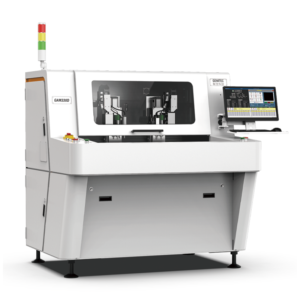

A PCB depaneling machine with a failure rate of 0.8% and MTTR of 12 minutes will lose approximately 42 hours of production annually in a continuous 24/7 operation—equivalent to 2,100 missed boards at a 50 boards/hour throughput rate. This calculation assumes 8,760 operating hours per year and directly links reliability metrics to production capacity, making failure rate and MTTR critical parameters for equipment selection and maintenance strategy development.
Quantifying Failure Rate in Depaneling Operations
Failure rate in depaneling equipment is typically expressed as the number of stoppage events per 1,000 operating hours or as mean time between failures (MTBF). Industrial spindle-based depanelers operating at 40,000-60,000 RPM commonly exhibit MTBF values ranging from 800 to 2,500 hours, depending on spindle bearing quality, dust extraction efficiency, and preventive maintenance intervals. Router bit breakage represents the most frequent failure mode, occurring every 150-400 linear meters of cutting path when processing FR-4 material with a copper weight of 1-2 oz/ft². Spindle bearing failure, while less frequent, carries higher repair complexity, typically manifesting after 3,000-5,000 operating hours when contamination from glass fiber dust exceeds IP54 sealing thresholds. The failure rate calculation must account for both catastrophic failures requiring immediate intervention and degradation events—such as cutting edge wear exceeding 0.02mm radius—that progressively reduce cut quality and increase mechanical stress on the PCB substrate.
MTTR Components and Repair Complexity Tiers
Mean Time To Repair encompasses fault detection, diagnosis, spare part retrieval, physical repair, and verification testing. For depaneling equipment, MTTR varies significantly across failure categories. Tier 1 failures—such as router bit replacement or feed rate adjustment—typically require 3-8 minutes, assuming operators maintain a bit inventory within 2 meters of the machine and follow standardized changeover procedures documented per IPC-2610 guidelines. Tier 2 failures, including spindle motor replacement or linear guide rail realignment, demand 45-120 minutes, requiring trained technicians and precision measurement tools such as dial indicators with 0.001mm resolution. Tier 3 failures involving control system PCB replacement, servo drive reconfiguration, or firmware restoration can extend MTTR to 4-8 hours, particularly when proprietary software requires factory-level authentication for parameter reloading. A weighted MTTR calculation must reflect the proportional distribution of these failure tiers: typically 70% Tier 1, 25% Tier 2, and 5% Tier 3 for well-maintained systems operating in temperature-controlled environments (20-25°C, 40-60% RH).
Production Impact Modeling and Throughput Loss
The relationship between failure rate, MTTR, and production loss follows a non-linear curve when considering downstream process dependencies. In an SMT line configuration where the depaneler feeds directly into an automated optical inspection (AOI) station and selective soldering system, each depaneler stoppage creates a cascading idle period across 2-3 downstream machines. The effective production loss per failure event equals MTTR multiplied by the number of affected stations, assuming no buffer inventory exists between processes. For a depaneler processing 60 boards per hour with an average MTTR of 15 minutes, each failure event loses 15 boards from depaneling output plus an additional 30 board-equivalents of downstream capacity if the AOI and selective soldering stations remain idle. This multiplier effect elevates the decision significance of MTTR beyond simple uptime calculations, particularly for high-mix, low-volume production environments where changeover flexibility already constrains overall equipment effectiveness (OEE).
Maintenance Strategy Selection Based on Reliability Metrics
Failure rate and MTTR data directly inform the optimal maintenance strategy: run-to-failure, preventive, or predictive. Equipment demonstrating failure rates below 0.5 events per 1,000 hours with MTTR under 10 minutes may justify run-to-failure approaches, where the total cost of unplanned repairs remains lower than scheduled maintenance labor and parts consumption. Conversely, systems exceeding 2.0 failures per 1,000 hours with MTTR above 30 minutes require preventive maintenance intervals calibrated to MTBF statistics—typically set at 0.6 to 0.8 × MTBF to intercept wear-out failures before functional breakdown. Predictive maintenance becomes viable when failure modes exhibit measurable precursors: spindle vibration exceeding 2.5 mm/s RMS velocity, cutting acoustic emission shifts beyond 15 dB from baseline, or motor current draw increasing more than 20% under constant load conditions. Vibration monitoring systems compliant with ISO 10816-3 standards can detect bearing degradation 200-500 operating hours before catastrophic failure, converting potential Tier 2 unplanned events into scheduled Tier 1 interventions during planned production windows.
Total Cost of Ownership Integration
The decision significance of failure rate and MTTR extends to total cost of ownership (TCO) models that compare equipment alternatives across a 5-7 year lifecycle. A depaneler with 15% higher capital cost but 40% lower failure rate and 50% shorter MTTR may deliver lower lifetime cost when accounting for lost production value. Assuming a product margin of $12 per board and a throughput of 50 boards per hour, each hour of unplanned downtime costs $600 in gross margin opportunity. Over a 5-year period, the difference between a system with 1.5 failures/1,000 hours at 25-minute MTTR versus 0.6 failures/1,000 hours at 10-minute MTTR represents approximately 105 additional hours of production—equivalent to $63,000 in recovered margin. This calculation excludes secondary costs such as expedited spare parts shipping, overtime labor for after-hours repairs, and quality losses from boards processed immediately after equipment recovery, where cutting parameter drift may remain undetected until post-depaneling inspection reveals edge burrs exceeding 0.05mm or micro-cracking extending beyond 0.1mm from the cut edge.
Technical Summary
Failure rate and MTTR serve as primary determinants of depaneling equipment productivity, with their combined impact extending beyond simple availability calculations to influence maintenance strategy selection, downstream process efficiency, and lifecycle cost economics. Quantifying these metrics with statistical rigor—tracking failure modes, repair durations, and production losses across a minimum 12-month observation period—provides the empirical foundation for equipment specification, spare parts inventory sizing, and maintenance interval optimization that directly affects manufacturing throughput and profitability.
Recommended Equipment
Looking for proven depaneling solutions? Seprays offers a full range of equipment backed by 30+ years of industry experience. Here are two options worth considering for your production line:
- GAM330AT Fully Automatic PCB Depaneling Machine — Self-feeding operation with automatic sorting — ideal for high-volume automated production lines
- GAM300AT Double-Layer Track Online PCB Board Separation Machine — Full-carrier process with carrier return track — built for seamless full-line automation
Frequently Asked Questions
Q1: How does MTTR differ from MTBF in evaluating depaneler reliability, and which metric matters more for high-mix production lines?
A1: MTBF (Mean Time Between Failures) indicates how often a depaneler is expected to fail, while MTTR measures the average downtime required to restore operation after a failure occurs. For high-mix lines with frequent changeovers, MTTR is often more critical because a machine with a higher failure rate but 15-minute MTTR can still outperform one with a low failure rate but 2-hour MTTR, keeping overall equipment effectiveness (OEE) higher. Per IPC-9821 guidelines, both metrics should be evaluated together as their product determines total unplanned downtime.
Q2: What failure rate threshold should I use as a decision cutoff when comparing depanelers for a 24/7 SMT production environment?
A2: For continuous 24/7 operation, a depaneler failure rate exceeding 2,000 FIT (approximately one failure per 500,000 operating hours) should raise concern, as this translates to roughly 3–4 unplanned stops per year per machine. Production managers should also demand documented field data rather than theoretical calculations, since real-world failure rates in abrasive routing and laser depaneling systems typically run 1.5× to 3× higher than manufacturer specifications due to dust contamination and spindle wear under sustained operation.
Q3: Our current depaneler has an MTTR of 90 minutes — what design features should we prioritize in a replacement to cut that below 30 minutes?
A3: Prioritize tool-less spindle access with quick-change cartridge systems, which can reduce spindle replacement from 60+ minutes to under 10 minutes, and modular electronic subassemblies with fault-code LED diagnostics that eliminate step-by-step board-level troubleshooting. Machines with remote diagnostics capability and pre-aligned fixture systems for routing bits further compress repair time; field data from automated lines shows that these features consistently bring MTTR into the 15–25 minute range, aligning with IPC-OEE targets above 85% for critical bottleneck stations.
About Seprays
About Seprays Precision Machinery
Founded in 1993, Seprays has over 30 years of expertise in PCB depaneling solutions. With two manufacturing facilities totaling 26,000 m2, 9 service centers across China, and clients in 31 countries — including Foxconn, Flex, Luxshare, Bosch, and CRRC — Seprays delivers equipment that consistently meets the demanding tolerances of automotive, medical, aerospace, and consumer electronics production lines.
Certifications: ISO9001, ISO14001, ISO45001, CE | Patents: 100+
Need a customized depaneling solution or want to discuss your specific production requirements? Our technical team is ready to help.
Contact: jimmy@seprays.com