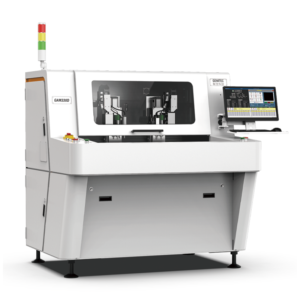

With PCB depaneling accuracy requirements tightening to ±0.02mm for rigid-flex boards and component clearance dropping below 1.5mm in high-density SMT assemblies, the Suzhou cluster in Jiangsu Province has consolidated a manufacturing ecosystem capable of delivering depaneling systems with spindle runout tolerances held to <3μm and inline stress levels maintained below 350με as measured by room-temperature curvature methods per IPC-9704.
Supply Chain Density and Component Sourcing Lead Times
The concentration of precision mechanical component suppliers within a 50km radius of Suzhou Industrial Park reduces lead times for critical depaneling machine subsystems to 5-7 working days, compared to 21-28 days for equivalent imports. High-speed spindle modules rated at 60,000-80,000 RPM with ER-11 collet interfaces are sourced from local precision bearing manufacturers holding P4 accuracy grades per ISO 492, enabling depaneling machines to maintain cutting surface roughness below Ra 1.6μm on FR-4 substrates with thicknesses from 0.4mm to 3.2mm. Linear guide rail suppliers within the cluster provide C3-grade Hiwin or THK equivalents with positioning repeatability of ±0.005mm, supporting depaneling feed rates of 300mm/s without introducing vibration-induced micro-cracks detectable by 20× optical inspection. The local supply chain integration extends to CNC-machined machine bases with stress-relieved Meehanite castings, achieving static stiffness values exceeding 50N/μm at the cutting head, which directly translates to board edge straightness within ±0.03mm over 300mm travel for routed depaneling profiles.
Cutting Precision and Tooling Technology
Depaneling machines produced within the Suzhou cluster routinely achieve depaneling tolerances of ±0.05mm on routed contours and ±0.02mm on sawn edges using 0.8mm to 2.0mm diamond-coated router bits with flute geometries optimized for 1,000-3,000mm/s feed rates. Spindle systems operating at 40,000-60,000 RPM with axial runout below 2μm enable depth-of-cut control within ±0.03mm across multi-up panel arrays containing 8-12 individual PCBs. Tool wear monitoring systems integrated into the control software trigger automatic tool change when cutting force exceeds 12N on 1.6mm FR-4, preventing edge delamination that would violate IPC-A-600 Class 2 or Class 3 acceptance criteria. The cluster’s manufacturers have standardized on servo-driven Z-axis control with 0.001mm resolution, allowing programmed tab-break sequences that limit peak stress to <400με during the final separation stage, a critical parameter for boards populated with BGAs exceeding 25mm on any side.
Stress Control and IPC Standards Compliance
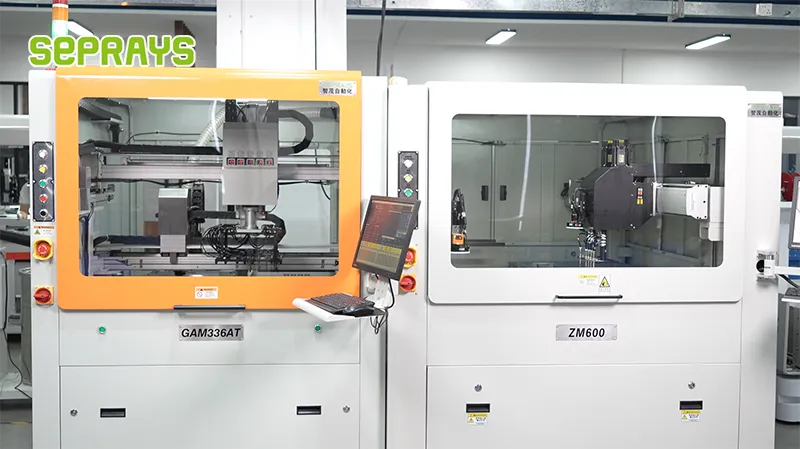
In-line stress measurement using shadow moiré or room-temperature curvature methods confirms that depaneling systems from the Suzhou cluster maintain residual stress below 500με for 90% of production scenarios, with optimized feed rate and spindle speed combinations reducing stress to 250-350με for sensitive flexible-rigid combinations. Stress reduction is achieved through multi-pass routing strategies with entry and exit ramp angles of 15-30 degrees, limiting sudden tool engagement that generates transient forces exceeding 20N. Depaneling programs are validated against IPC-9704 Attachment Reliability Test Methods for Surface-Mount Solder Attachments, with strain gauge data logged at 2,000 samples per second during the depaneling cycle to verify compliance with Class 3 requirements for aerospace and medical electronics. Vibration damping systems incorporating polyurethane isolation mounts with natural frequencies of 8-12Hz reduce transmitted cutting vibration to <0.5g at BGA locations, directly improving temperature cycle performance by preventing solder joint micro-cracking during subsequent assembly reflow.
Automation Integration and Throughput Metrics
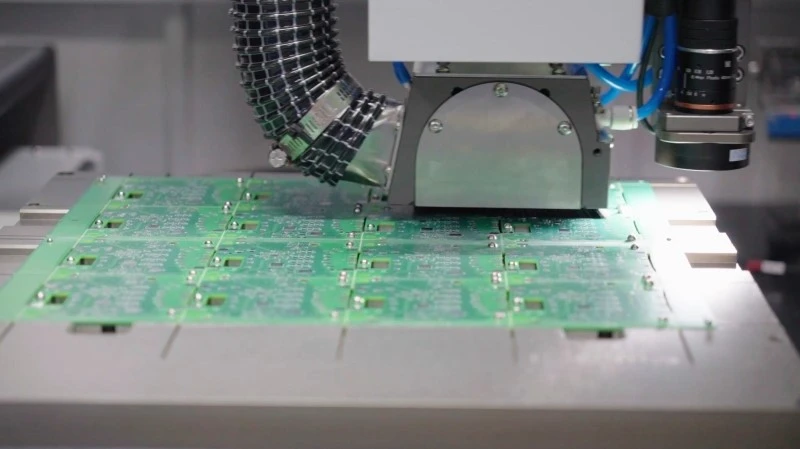
Inline depaneling cells integrated with SMEMA-compatible conveyors achieve throughput rates of 300-450 boards per hour for standard 100mm×150mm panels, with servo-driven board handling systems providing positional accuracy of ±0.1mm at transfer points. Vision alignment systems using 5-megapixel cameras with telecentric lenses achieve fiducial recognition repeatability of ±0.01mm, enabling depaneling of panels with SMT components placed as close as 0.8mm to the routing path without requiring additional clearance offsets. The Suzhou cluster has developed standardized modular machine frames supporting rapid changeover between panel formats, with pneumatic fixture clamping systems achieving full tooling swap in 8-12 minutes for panel sizes ranging from 50mm×50mm to 450mm×350mm. Dust extraction systems integrated into the depaneling enclosure maintain capture velocities exceeding 0.5m/s at the cutting zone, complying with ISO Class 5 cleanroom requirements for medical and automotive electronics assembly environments where particulate contamination must remain below 3,520 particles per cubic meter for sizes ≥0.1μm.
Technical Summary
The Suzhou PCB depaneling machine cluster delivers measurable technical advantages through integrated supply chain responsiveness, precision mechanical subsystems achieving ±0.02mm cutting tolerances, and stress-controlled depaneling processes validated against IPC-9704 standards with residual stress maintained below 350με for production environments. Spindle systems operating at 60,000-80,000 RPM combined with vision-guided fiducial alignment enable depaneling of high-density SMT panels at throughput rates of 300-450 boards per hour while maintaining edge quality within IPC-A-600 Class 3 acceptance criteria. The cluster’s capability to deliver complete depaneling systems with local lead times of 5-7 days for critical components, combined with automated tool wear monitoring and SMEMA-compatible inline integration, positions Suzhou-manufactured depaneling equipment as a technically defensible choice for electronics manufacturers requiring high-yield, low-stress PCB separation processes.
Recommended Equipment
Looking for proven depaneling solutions? Seprays offers a full range of equipment backed by 30+ years of industry experience. Here are two options worth considering for your production line:
- GAM300AT Double-Layer Track Online PCB Board Separation Machine — Full-carrier process with carrier return track — built for seamless full-line automation
- GAM330AT Fully Automatic PCB Depaneling Machine — Self-feeding operation with automatic sorting — ideal for high-volume automated production lines
Frequently Asked Questions
Q1: What production throughput improvements can a PCB depaneling machine cluster achieve compared to a
single machine setup in high-volume manufacturing?
A1: A cluster configuration of multiple depaneling machines enables parallel processing of PCB panels, typically achieving 3-5x throughput increase depending on the number of units deployed. This parallel operation significantly reduces per-board cycle time while maintaining consistent quality across all units through standardized tooling and identical process parameters. For high-mix production environments, the cluster allows flexible workload distribution across machines to optimize OEE.
Q2: How does the geographical concentration of PCB depaneling equipment suppliers in Suzhou and surrounding Jiangsu regions benefit local electronics manufacturers in terms of maintenance and support?
A2: Manufacturers in this region typically achieve response times of 4-8 hours for on-site technical support, compared to 24-48 hours for facilities in remote locations. The established supply chain also ensures faster delivery of spare consumables such as blades, drive belts, and precision linear guides, minimizing unplanned downtime. Local supplier presence enables regular preventive maintenance visits and process optimization consultations at reduced cost.
Q3: What are the critical tolerance specifications that a PCB depaneling machine cluster must maintain to ensure IPC Class 3 compliance for medical and aerospace electronics?
A3: For IPC Class 3 applications, individual machines within the cluster must maintain positional accuracy of ±0.05mm (2 sigma) with repeatability of ±0.025mm across all units. Edge quality must meet IPC-A-600H specifications with no visible burrs exceeding 0.13mm on the depaneled edges. Cross-machine consistency requires that dimensional measurements of depaneled boards vary no more than ±0.08mm between any two machines in the cluster, verified through regular SPC monitoring per IPC guidelines.
About Seprays
About Seprays Precision Machinery
Founded in 1993, Seprays has over 30 years of expertise in PCB depaneling solutions. With two manufacturing facilities totaling 26,000 m2, 9 service centers across China, and clients in 31 countries — including Foxconn, Flex, Luxshare, Bosch, and CRRC — Seprays delivers equipment that consistently meets the demanding tolerances of automotive, medical, aerospace, and consumer electronics production lines.
Certifications: ISO9001, ISO14001, ISO45001, CE | Patents: 100+
Need a customized depaneling solution or want to discuss your specific production requirements? Our technical team is ready to help.
Contact: jimmy@seprays.com