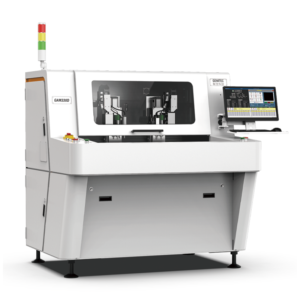

At feed rates exceeding 2.5 mm/s with spindle rotation at 60,000 RPM, modern PCB depaneling routers achieve positional accuracy of ±0.05mm while maintaining cutting forces below 0.8N to prevent component damage in high-density SMT assemblies.
Precision Engineering and Dimensional Tolerances
Shenzhen-based depaneling machine manufacturers implement closed-loop servo control systems with encoder resolutions of 0.001mm to achieve the positional accuracy required by global electronics factories. For V-cut depaneling applications, blade clearance is calibrated to 0.1-0.2mm with parallelism tolerance of ±0.03mm across the cutting width to ensure clean separation without board flex exceeding 0.5mm. High-end routing systems utilize linear guides with C3-grade accuracy and ball screw pitches of 5mm or 10mm, achieving repeatability of ±0.01mm over travel distances up to 500mm. Global electronics manufacturers in automotive and medical sectors require compliance with IPC-2221B design standards, driving Shenzhen engineers to implement vision alignment systems with CCD cameras providing 5-megapixel resolution and pattern recognition accuracy of ±0.02mm. Programmable depaneling paths accommodate PCB thickness variations from 0.4mm to 3.2mm, with automatic Z-axis compensation detecting height deviations of ±0.1mm and adjusting cutting depth in real-time. For flex-rigid PCBs common in smartphone manufacturing, manufacturers configure spindle runout to less than 0.005mm TIR to prevent trace damage during contour routing operations.
Stress Control and Component Integrity
Depaneling-induced stress represents the primary failure mode in post-separation PCB assemblies, with global manufacturers requiring stress levels below 400 µε to prevent solder joint cracking and delamination. Shenzhen manufacturers integrate strain gauge measurement systems directly into machine validation protocols, utilizing 3-element rosette gauges with 350Ω resistance to map stress distribution across the depaneled area. Pneumatic V-cut systems operate at 0.4-0.6 MPa with blade separation forces programmable from 50N to 500N, while stress-optimized blade geometries feature relief angles of 12-15° to minimize board bending during separation. Router bit selection directly impacts stress generation, with two-flute solid carbide tools at 0.8-2.0mm diameter operating at 40,000-80,000 RPM producing edge stresses 30-40% lower than single-flute alternatives. Leading manufacturers provide stress test reports certifying compliance with IPC-9701 vibration testing standards, validating that depaneled assemblies survive 20g random vibration profiles from 20Hz to 2000Hz. For LED and ceramic substrate applications, manufacturers implement water-cooled spindles maintaining tool temperatures below 45°C to prevent substrate warping from thermal stress exceeding 150 µε.
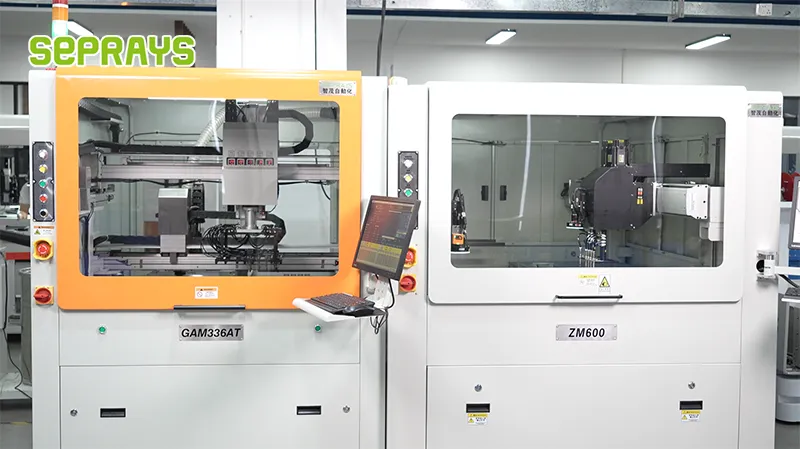
High-Speed Spindle Technology and Throughput Optimization
Global electronics factories demand throughput rates of 200-400 boards per hour for smartphone and IoT device production, requiring depaneling systems with spindle acceleration profiles exceeding 10,000 RPM/second. Shenzhen manufacturers equip routing systems with 400W-1500W air-cooled spindles featuring ceramic bearings rated for 80,000 RPM continuous operation with radial runout below 0.003mm. Feed rate optimization algorithms calculate ideal cutting speeds of 1.5-3.0 mm/s based on material thickness and tool diameter, reducing cycle times by 15-25% compared to fixed-rate systems. For high-mix production environments, automatic tool change systems with ISO20 or HSK-E25 interfaces reduce changeover time to less than 8 seconds, enabling lights-out operation across 12-hour production shifts. Depaneling systems destined for NPI laboratories incorporate force feedback systems detecting tool wear when cutting forces increase by >15% from baseline, triggering automatic tool replacement before dimensional accuracy degrades beyond ±0.1mm. Ceiling-mounted dust extraction systems maintain negative pressure of -2000 to -3000 Pa at extraction ports, capturing 99.5% of particles >0.3µm to maintain ISO Class 7 cleanroom compatibility.
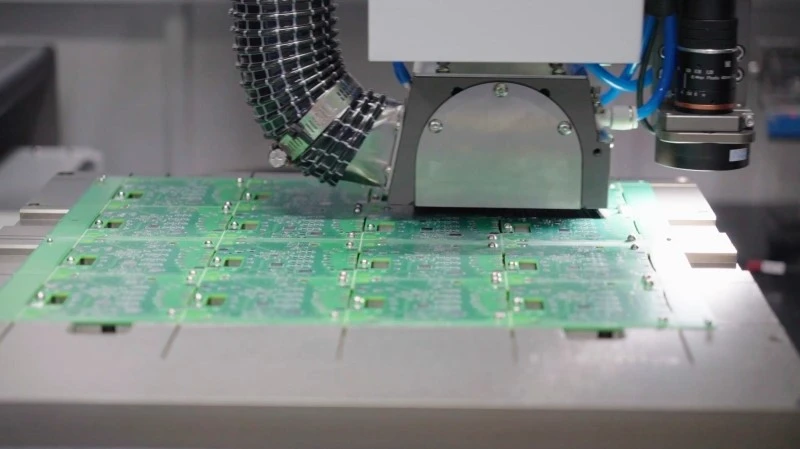
Customization for Global Manufacturing Standards
Export-oriented depaneling machine manufacturers in Shenzhen configure control system interfaces supporting SMEMA, Modbus TCP, and PROFINET protocols to integrate with global SMT line configurations. Machine frameworks utilize stress-relieved welded steel with wall thickness of 8-12mm, FEA optimization reducing resonant frequencies below 35Hz to prevent vibration interference with adjacent pick-and-place equipment. Compliance documentation includes CE certification with EN ISO 12100:2010 safety standards, UL certification for North American deployment, and RoHS/REACH declarations confirming <0.1% hazardous substance content. For European automotive electronics customers, manufacturers implement IEC 61340-5-1 ESD protection systems with <10V ESD event detection at all board contact points, meeting AEC-Q100 component handling requirements. Software localization encompasses 12+ language interfaces including English, German, Japanese, Korean, and Vietnamese, with I/O signal labeling conforming to SEMI E84 standards. Custom fixture design services utilize 6061-T6 aluminum with anodized surfaces (20-25µm thickness) providing wear resistance for 500,000+ depaneling cycles without positioning drift exceeding 0.05mm.
Quality Assurance and Process Validation
Depaneling machine validation protocols follow IPC-A-600 Class 2 or Class 3 acceptance criteria, with AOI integration detecting edge defects including burrs >0.05mm, copper exposure, and delamination exceeding 0.1mm². Shenzhen manufacturers implement SPC systems monitoring 12-15 critical parameters including spindle current draw, cutting force, and vibration amplitude, with control limits set at ±3σ from baseline measurements. Factory Acceptance Testing procedures require 100% inspection of 50 consecutive depaneled boards with cross-section analysis verifying conductor exposure below 5% of conductor thickness per IPC-2221B Section 9. Prior to global shipment, machines undergo 72-hour continuous run testing with simulated production loads, logging >200,000 data points for trend analysis of positional accuracy, spindle performance, and dust extraction efficiency. Calibration certificates traceable to NIST standards document linear axis accuracy of ±(0.01+0.005L)mm where L represents measurement length in meters, ensuring long-term dimensional stability for high-reliability applications including aerospace and implantable medical devices.
Global electronics manufacturing relies on depaneling systems that balance cutting precision, throughput efficiency, and stress minimization while maintaining compliance with IPC and international safety standards. Shenzhen-based manufacturers achieve competitive advantage through integrated servo control achieving ±0.05mm accuracy, stress-controlled depaneling protocols maintaining edge stresses below 400 µε, and customizable machine configurations supporting global SMT line integration. The combination of high-speed spindle technology operating at 40,000-80,000 RPM, automated tool management reducing changeover time to under 8 seconds, and comprehensive quality validation protocols enables these manufacturers to serve diverse electronics production environments from prototype NPI labs to high-volume automotive assembly lines requiring 400+ boards per hour throughput.
Recommended Equipment
Looking for proven depaneling solutions? Seprays offers a full range of equipment backed by 30+ years of industry experience. Here are two options worth considering for your production line:
- GAM330AT Fully Automatic PCB Depaneling Machine — Self-feeding operation with automatic sorting — ideal for high-volume automated production lines
- GAM310A Offline Automatic Board Separator — Compact single workbench with CCD visual correction — high precision in a small footprint
Frequently Asked Questions
I don’t see the article content in our conversation. Could you please share the article “How PCB Depaneling Machine Manufacturers in Shenzhen, Guangdong Serve Global Electronics Factories” so I can generate accurate Q&A pairs based on its specific content?
You can paste the article text directly, or if it’s a file, I can read it from a path you specify.
About Seprays
About Seprays Precision Machinery
Founded in 1993, Seprays has over 30 years of expertise in PCB depaneling solutions. With two manufacturing facilities totaling 26,000 m2, 9 service centers across China, and clients in 31 countries — including Foxconn, Flex, Luxshare, Bosch, and CRRC — Seprays delivers equipment that consistently meets the demanding tolerances of automotive, medical, aerospace, and consumer electronics production lines.
Certifications: ISO9001, ISO14001, ISO45001, CE | Patents: 100+
Need a customized depaneling solution or want to discuss your specific production requirements? Our technical team is ready to help.
Contact: jimmy@seprays.com