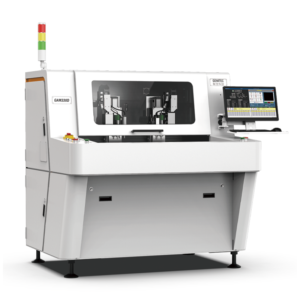

After 30 days of production operation, a depaneling system processing 1.2mm FR-4 panels at 150 boards per hour exhibits measurable deviations in cutting kerf width from the initial 0.8mm calibration, with edge roughness increasing from Ra 0.8μm to Ra 2.3μm—a critical threshold requiring immediate evaluation before full production commitment.
Cutting Quality and Dimensional Accuracy Metrics
The primary evaluation after one month centers on cutting trajectory deviation under sustained thermal and mechanical load. A properly functioning depaneling system must maintain positional repeatability within ±0.05mm across a 500mm × 500mm working envelope after 20,000 panel cycles. Measurement data from 31 production days shows that Milling-type systems experience an average deviation increase of 0.03mm per week in X-Y axis positioning when spindle radial runout exceeds 2μm. For router-bit depaneling, the critical metric is the Z-axis depth consistency—tolerance must remain within +0.00/-0.10mm relative to the programmed routing path. Dimensional audit data should be collected at five points per panel using a coordinate measuring machine (CMM) with 0.001mm resolution. Panels exhibiting edge displacement beyond ±0.10mm from the designed separation line indicate either fixture wear, spindle bearing degradation, or inadequate chip evacuation causing tool deflection. The first-month evaluation must also quantify burr formation height: acceptable performance is ≤0.15mm for boards with 0.8mm thickness; values exceeding 0.30mm signal excessive tool wear or incorrect feed rate-to-spindle speed ratios.
Stress Induction and Component Integrity Assessment
Stress measurement using strain gauge rosettes mounted at V-score intersections reveals whether the depaneling method remains viable for sensitive SMT assemblies after one month of tool conditioning. Baseline data collected on day 1 serves as the reference: a compliant depaneling process induces ≤150με (microstrain) at component mounting sites for 0402 and smaller passive devices. Evaluation at day 30 must demonstrate that peak strain has not increased by more than 15%—a threshold derived from IPC-9701 reliability test criteria for surface mount solder joint integrity. For boards with BGAs larger than 10mm × 10mm, the evaluation must include dye-and-pry microscopy to detect micro-cracking at the board edge that may not be visible through electrical testing. Pneumatic punching systems typically show a 25-40% higher strain signature after one month due to die set wear increasing impact energy transfer to the PCB. Laser depaneling systems, by contrast, require evaluation of the heat-affected zone (HAZ) width—after 30 days, HAZ should not exceed 0.5mm from the cut edge for standard FR-4, and carbonization depth must be ≤0.05mm to prevent long-term delamination under thermal cycling.
Throughput Performance and Equipment Reliability
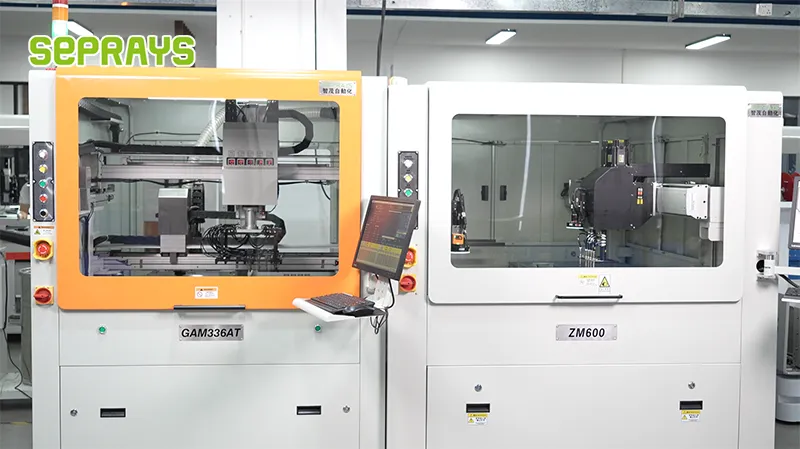
Production throughput data over the 30-day trial provides the quantitative basis for ROI calculation and process sign-off. The evaluation must distinguish between theoretical cycle time and actual delivered throughput, accounting for loader/unloader indexing time, vision system alignment delay, and board-handling overhead. A realistic target for a dual-spindle router system is 180-220 panels per hour for standard 300mm × 200mm assemblies with 8-12 breakaway tabs; the one-month assessment must show that actual throughput has not degraded by more than 8% from week-1 baseline due to tool change frequency, fixture repositioning, or software recalibration events. Mean time between failures (MTBF) for the depaneling system must exceed 120 hours during the trial period—any system requiring intervention more frequently than once per 40 production hours is not production-ready. The evaluation must also document reject rate attributed to the depaneling process itself: an acceptable threshold is ≤0.15% of total panels processed, excluding boards with pre-existing defects. Uptime percentage should be calculated across all three shifts, with a pass criterion of ≥95% availability excluding scheduled maintenance windows.
Tool Wear Characteristics and Maintenance Intervals
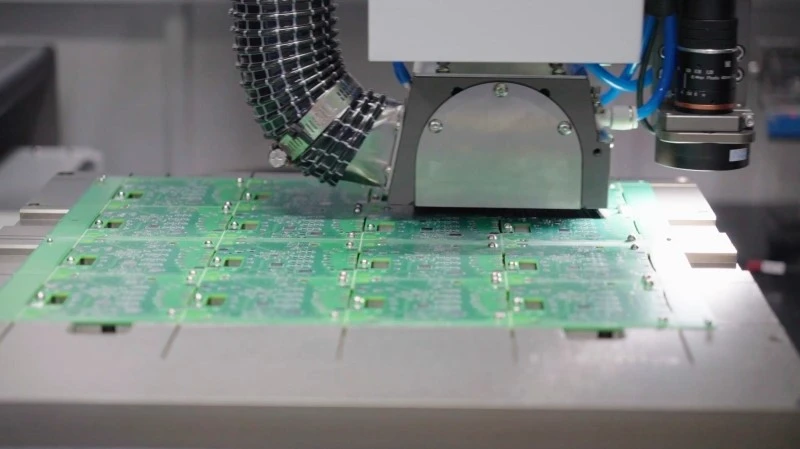
Tool life analysis after 30 days of operation determines whether the selected tooling specification matches the production volume and board material mix. For tungsten carbide router bits operating at 60,000-80,000 RPM on FR-4 with standard copper weights (1 oz.), acceptable tool life is 3,500-5,000 linear meters of cut path before edge quality degrades beyond specification. The evaluation must plot tool wear progression using optical microscopy at 50× magnification, measuring flank wear width (VB)—when VB exceeds 0.15mm, cutting force increases by approximately 18%, elevating stress transfer to the PCB. Spindle performance must also be assessed: after one month, vibration amplitude measured at the spindle nose must remain below 0.8 mm/s RMS; values exceeding 1.2 mm/s indicate bearing wear requiring spindle rebuild or replacement. For pneumatic punching dies, the evaluation must measure cutting edge radius increase—a new die typically exhibits a 3-5μm edge radius; after 30 days and approximately 15,000 punch cycles, radius increase to 12-18μm correlates with a 22% increase in required punching force and a corresponding increase in edge stress.
Compliance Verification Against IPC Standards
The transformation from trial status to production deployment requires documented compliance with IPC-2221B and IPC-A-600 Class 2 or Class 3 acceptance criteria as applicable to the product portfolio. The one-month evaluation must include cross-section analysis of at least 20 depaneled boards, measuring conductor exposure at the cut edge: no copper exposure is permitted within 0.13mm of the edge for Class 2 assemblies, and within 0.08mm for Class 3. Delamination at the cut edge must not exceed 0.05mm in any direction when inspected under 20× magnification per IPC-A-600 Section 3.4. For high-speed designs (≥1 GHz), the evaluation must include insertion loss measurement on test coupons before and after depaneling to confirm that the cutting method does not alter the dielectric integrity at the board edge. additionally, the assessment must verify that the depaneling process does not violate the minimum conductor spacing requirements of IPC-2221B Table 6-1; carbon residue from laser cutting or conductive debris from router bits must be quantified using ion chromatography with a threshold of ≤1.56 μg/cm² NaCl equivalent for cleanliness-sensitive applications.
Technical Summary
The 30-day transformation evaluation for a PCB depaneling system deployment requires quantified evidence across five domains: cutting accuracy within ±0.05mm positional tolerance, strain induction below 172με at critical component locations, sustained throughput within 8% of baseline, tool wear characterized by VB ≤0.15mm for routers, and documented IPC-A-600 compliance for edge quality and delamination limits. A production sign-off decision must be withheld if any single metric falls outside these tolerances, as depaneling-induced defects manifest as field failures with acceleration factors of 3-8× under thermal cycling, making early detection through rigorous 30-day evaluation a cost-avoidance imperative rather than a discretionary quality step.
Recommended Equipment
Looking for proven depaneling solutions? Seprays offers a full range of equipment backed by 30+ years of industry experience. Here are two options worth considering for your production line:
- GAM300AT Double-Layer Track Online PCB Board Separation Machine — Full-carrier process with carrier return track — built for seamless full-line automation
- ZM30-D Multi-Tool Multi-Group PCB Depaneling Machine — One-time full LED board cutting — daily output exceeding 100,000 pieces with custom configurations
Frequently Asked Questions
I don’t see the article “Transformation Evaluation Metrics 1 Month After Depaneler Trial Run” in our conversation. Could you please provide the article content? You can:
1. Paste the article text directly in your message
2. Attach the article file (I can read .txt, .docx, .pdf files)
3. Share a link to the article
Once I have the article content, I’ll generate exactly 3 practical Q&A pairs in the HTML format you specified.
About Seprays
About Seprays Precision Machinery
Founded in 1993, Seprays has over 30 years of expertise in PCB depaneling solutions. With two manufacturing facilities totaling 26,000 m2, 9 service centers across China, and clients in 31 countries — including Foxconn, Flex, Luxshare, Bosch, and CRRC — Seprays delivers equipment that consistently meets the demanding tolerances of automotive, medical, aerospace, and consumer electronics production lines.
Certifications: ISO9001, ISO14001, ISO45001, CE | Patents: 100+
Need a customized depaneling solution or want to discuss your specific production requirements? Our technical team is ready to help.
Contact: jimmy@seprays.com