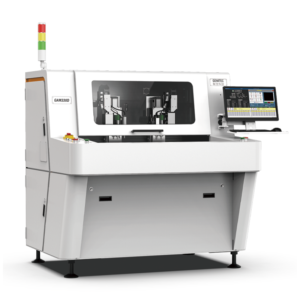

Printer consumable circuit boards present unique depaneling challenges due to their high-density routing patterns and sensitive components — a typical ink cartridge control board contains over 200 closely spaced V-scored break-out tabs with component clearances as tight as 1.2mm from cut lines. In production environments processing 800-1200 boards per hour, accumulated cutting stress must remain below 150μstrain to prevent latent fractures in the ceramic capacitors and crystal oscillators commonly found on these boards.
Technical Requirements for Printer Consumable PCBs
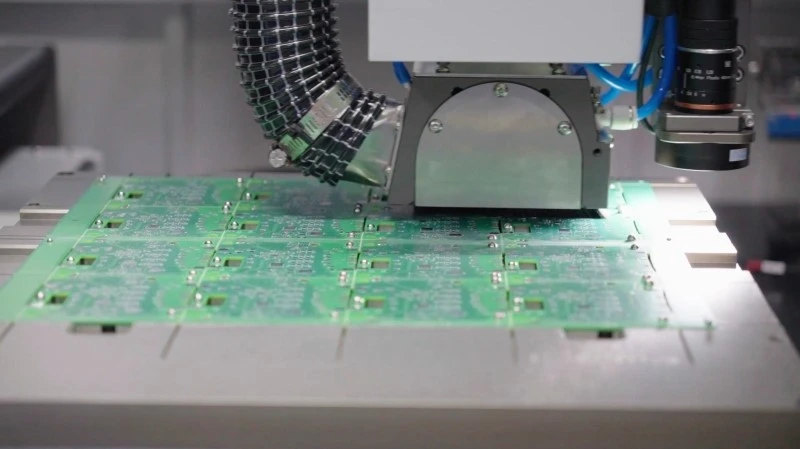
Printer consumable circuit boards differ significantly from standard consumer electronics PCBs. The boards typically use FR-4 material with thicknesses ranging from 0.8mm to 1.6mm, but the critical factor is component proximity to cut paths. Memory chips and timing crystals are often positioned within 2-3mm of panel edges, making controlled cutting essential. Cutting tolerances must stay within ±0.05mm across a 300mm × 400mm work area to avoid component damage. The V-score depth typically measures 0.3-0.4mm per side on 1.6mm boards, leaving a web thickness of 0.8-1.0mm that requires precise blade positioning to separate cleanly without excess bending stress.
Spindle Configuration and Cutting Parameters
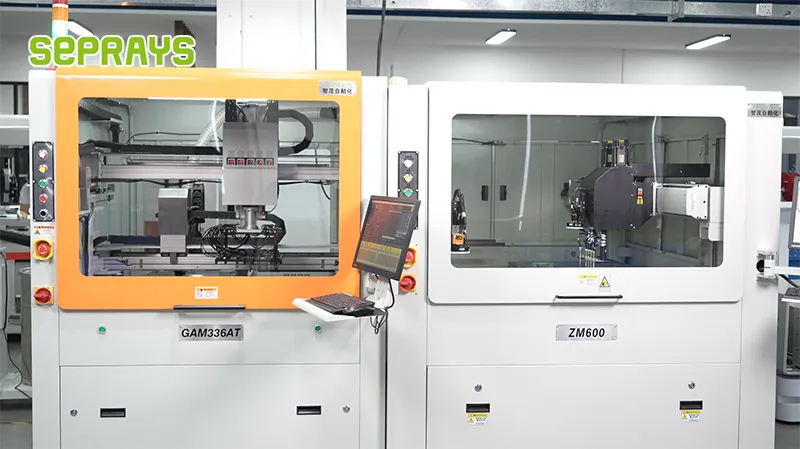
Modern depaneling systems for printer consumables employ dual-spindle configurations with independent Z-axis control. Spindle speeds range from 40,000 to 60,000 RPM for standard FR-4, with higher speeds of 60,000-80,000 RPM recommended for boards with ceramic components or thick copper layers. Feed rates of 300-500mm/min maintain acceptable surface finish below Ra 3.2μm while keeping cutting forces under 25N. Carbide cutting tools with 2-3 flutes and 3.0-3.2mm diameters provide optimal chip clearance. Tool life averages 15,000-20,000 linear meters of cut before replacement, though boards with high glass content in the substrate reduce this to 10,000-12,000 meters.
Stress Measurement and Component Protection
Cutting-induced stress remains the primary failure mode for printer consumable boards. Finite element analysis shows that traditional manual breaking generates peak stresses exceeding 300μstrain, while automated routing with optimized blade entry angles keeps stresses below 120μstrain. The entry angle should be limited to 15-20 degrees from vertical to minimize shock loading. Board support during cutting must prevent flexure beyond 0.5mm deflection, as excessive bending directly transfers stress to solder joints. Production data indicates that MLCC components rated at 25V and above tolerate cutting stress better than lower-voltage variants, with failure rates of 0.02% versus 0.15% for 10V components when cut under identical conditions.
Dust Extraction and Cleanroom Compatibility
Printer consumable manufacturing frequently operates in Class 10,000 (ISO Class 7) environments, demanding effective dust management. Routing operations generate particulate matter in the 10-100μm range at rates of 0.5-1.2 grams per 100 meters of cut. Extraction systems must achieve 4-6 air changes per minute at the cutting zone, with filtration efficiency exceeding 99.5% for particles above 5μm. Static elimination systems rated at 5-10kV neutralize charges that otherwise attract particulates to component surfaces. Improper dust control correlates with a 3-5% increase in post-depaneling cleaning requirements and potential contamination of ink delivery pathways on the assembled cartridges.
Process Qualification and IPC Compliance
Depaneling processes for printer consumables must meet IPC-A-610 Class 2 or Class 3 acceptance criteria, depending on the end application. Edge quality assessments require smooth surfaces free of fraying exceeding 0.1mm, with no copper delamination visible at 10× magnification. Dimensional verification confirms board outline accuracy within ±0.1mm of design intent. Statistical process control monitors blade wear by tracking cutting force trends, with control limits set at ±2σ from baseline. First-article inspection for each production lot must verify cutting path accuracy through coordinate measuring machine checks at minimum 12 points distributed across the panel. Real-time monitoring of spindle current draw provides indirect wear indication, with a 15% increase over baseline triggering preventive tool changes.
Summary
Successful depaneling of printer consumable circuit boards demands precise coordination of mechanical parameters — spindle speed, feed rate, and entry angle — with stress mitigation strategies that protect sensitive components within millimeters of cut lines. Production experience demonstrates that automated routing systems achieving ±0.05mm tolerance, cutting stresses below 150μstrain, and effective dust extraction deliver first-pass yields exceeding 99.5% while maintaining tool life of 15,000+ linear meters. Process qualification to IPC standards and continuous monitoring ensure consistent quality at the throughputs required for high-volume printer consumable manufacturing.
Recommended Equipment
Looking for proven depaneling solutions? Seprays offers a full range of equipment backed by 30+ years of industry experience. Here are two options worth considering for your production line:
- GAM310A Offline Automatic Board Separator — Compact single workbench with CCD visual correction — high precision in a small footprint
- GAM330AT Fully Automatic PCB Depaneling Machine — Self-feeding operation with automatic sorting — ideal for high-volume automated production lines
Frequently Asked Questions
I don’t see the article content in our conversation. Could you please provide the article “Experience of Zhuhai PCB Depaneling Machines in Depaneling Printer Consumable Circuit Boards” so I can generate accurate Q&A pairs based on its actual content?
You can paste the article text directly, upload the file, or share a link to it.
About Seprays
About Seprays Precision Machinery
Founded in 1993, Seprays has over 30 years of expertise in PCB depaneling solutions. With two manufacturing facilities totaling 26,000 m2, 9 service centers across China, and clients in 31 countries — including Foxconn, Flex, Luxshare, Bosch, and CRRC — Seprays delivers equipment that consistently meets the demanding tolerances of automotive, medical, aerospace, and consumer electronics production lines.
Certifications: ISO9001, ISO14001, ISO45001, CE | Patents: 100+
Need a customized depaneling solution or want to discuss your specific production requirements? Our technical team is ready to help.
Contact: jimmy@seprays.com