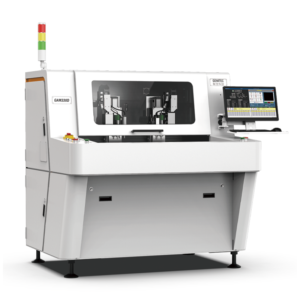

At depaneling feed rates exceeding 80 mm/s on 1.6 mm thick FR4 with a 2.0 mm diameter router bit, the combination of radial cutting force and spindle runout generates board edge stress exceeding 350 µε (microstrain), which directly correlates with PQFN package solder joint delamination in thermal cycling tests per IPC-9701. Before committing capital expenditure to a depaneling system, engineering teams must rigorously query suppliers on quantifiable machine specifications rather than marketing claims, because a 0.05 mm deviation in tool path accuracy translates to 15-20% reduction in board edge clearance for designs running 0.2 mm trace-to-edge spacing.
Cutting Accuracy and Repeatability Specifications
The first technical interrogation must focus on the linear positioning accuracy of the X/Y axes and the repeatability of the Z-axis depth control. Request the supplier to provide the actual TUV or equivalent calibration certificate showing positioning tolerance in mm/m, not just the brochure claim. A production-grade depaneling machine must hold ±0.05 mm linear accuracy across a 500 mm travel range; anything looser than ±0.10 mm will cause irregular tab remnants on milled slots, requiring manual rework that defeats the purpose of automation. Additionally, ask for the Cpk data of the Z-axis depth control—the depaneling bit must maintain cutting depth within ±0.03 mm of the programmed value to avoid hitting buried traces in multilayer boards with <0.15 mm dielectric thickness between the edge slot and inner layer 2. The supplier should also disclose the lead screw pitch error compensation map and whether the system uses linear scales (absolute encoders) or rotary encoders, because rotary encoder accumulation error over 300 mm travel can reach 0.12 mm without proper compensation.
Spindle Dynamics and Tool Life Metrics
Spindle performance directly determines cut quality and operating cost. The critical questions here are: what is the minimum and maximum continuous RPM, what is the collet runout at the nose, and how is tool wear monitored? For routing applications on FR4, aluminum-backed PCBs, and polyimide flex circuits, the spindle must maintain 40,000–80,000 RPM with ≤1.0 µm runout at the collet nose. Runout exceeding 2.0 µm accelerates tool wear by 40–60%, reducing tool life from the expected 80–120 meters of cut length to under 50 meters. Ask the supplier to provide the spindle power curve—a depaneling spindle operating at 60,000 RPM must deliver at least 0.8 kW continuous power to maintain chip load when cutting 2.4 mm thick Aluminum-backed PCB material. Also inquire about the tool life monitoring method: optical tool check, current draw monitoring, or vibration signature analysis. Systems relying solely on timer-based tool changes without wear feedback risk either premature tool changes (wasting consumables) or tool breakage mid-cycle, which can destroy an entire panel of 20–30 boards.
Stress Generation and Strain Measurement Data
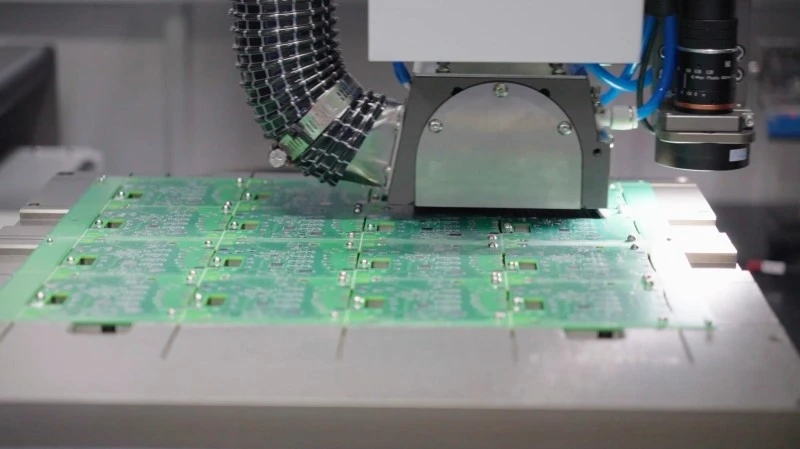
This is the most frequently overlooked technical area in supplier evaluations. Depaneling generates mechanical stress that can cause latent component failures, particularly for BGAs, LGAs, and large PQFN packages located within 5.0 mm of the board edge. Ask the supplier to provide strain gauge test data (per IPC-9704) showing the με levels generated by their machine at typical feed rates. A properly tuned system using stress-relief tool paths should keep peak strain below 250 µε for standard FR4 at 1.6 mm thickness. If the supplier cannot produce strain gauge data, ask for the specific stress-reduction methods implemented: directional tool path changes, variable feed rate control around components, or dual-pass milling strategies. Also ask about the minimum component-to-cut-line distance the machine can reliably achieve—modern systems with vision alignment and controlled feed should manage 0.75 mm for 0402 and larger packages, while older or less precise systems require 1.5–2.0 mm clearance, which directly impacts PCB real estate and design flexibility.
Throughput, Changeover Time, and Software Integration
A depaneling machine that cannot keep pace with the SMT line’s output is a bottleneck, not an asset. The key metric here is boards per hour sustained over an 8-hour shift, not peak single-panel cycle time. Ask for the theoretical vs. demonstrated throughput difference—a common gap is 30–40% due to unload/load time, vision alignment time, and dust extraction cycle delays. For panel sizes common in automotive electronics (320 × 250 mm with 12–18 boards), a capable system should achieve 300–450 boards/hour including load/unload. Equally important: inquire about changeover time when switching between different panel designs. Systems with automatic tool changers and vision-based fiducial recognition should achieve <3 minute changeovers; those requiring manual fixture changes and program re-teaching can take 20–45 minutes, which is unacceptable in high-mix production environments. Also ask about the software's CAD data import capability—can it directly import Gerber, ODB++, or IPC-2581 formats? Manual tool path programming for a 20-up panel can take 2–4 hours; automatic tool path generation from CAD data reduces this to under 10 minutes.
Maintenance Intervals, Spare Parts, and Compliance Documentation
The final set of questions addresses total cost of ownership and regulatory compliance. Ask for the documented preventive maintenance schedule with intervals expressed in operating hours, not vague “monthly” recommendations. Critical items include spindle bearing life (typically 1,500–2,500 hours depending on duty cycle and cooling), linear guide lubrication intervals, and dust extraction filter replacement frequency. Also request the MTBF (Mean Time Between Failure) data for the motion system—a well-designed depaneling machine should demonstrate >3,500 hours MTBF in production environments. On the compliance side, confirm that the machine’s dust extraction system meets the <0.1 mg/m³ particulate emission limit required under typical EMS indoor air quality standards, and request documentation showing CE, UL, or equivalent safety certification with the specific standards listed (EN ISO 12100, IEC 61010-1, etc.). Finally, ask about the supplier's spare parts stocking policy and local technical support response time—a 48-hour response SLA with local spare parts inventory is the minimum acceptable threshold for production-critical equipment.
Technical Summary
Procurement of a PCB depaneling system is fundamentally a decision about mechanical precision, stress control, and production integration—not simply a price comparison. The 10 questions outlined across these sections target the measurable parameters that distinguish a production-capable system from a mechanically inadequate one: ±0.05 mm positioning accuracy, <1.0 µm spindle runout at 60,000 RPM, peak strain below 250 µε per IPC-9704, sustained throughput exceeding 300 boards/hour, and documented MTBF above 3,500 hours. Suppliers unable to provide quantified test data for these parameters should be disqualified early in the evaluation process. The cost of a poorly specified depaneling machine is not the purchase price—it is the accumulated loss from rework, field failures, and production downtime over the system's operational life.
Recommended Equipment
Looking for proven depaneling solutions? Seprays offers a full range of equipment backed by 30+ years of industry experience. Here are two options worth considering for your production line:
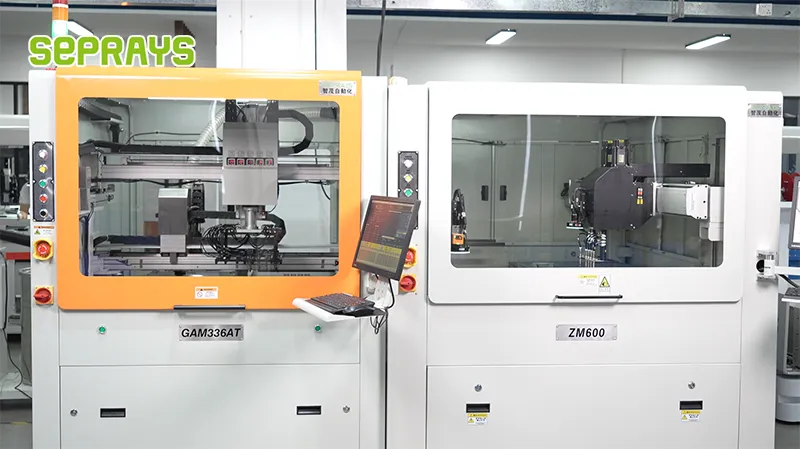
- ZM30-D Multi-Tool Multi-Group PCB Depaneling Machine — One-time full LED board cutting — daily output exceeding 100,000 pieces with custom configurations
- GAM330AT Fully Automatic PCB Depaneling Machine — Self-feeding operation with automatic sorting — ideal for high-volume automated production lines
Frequently Asked Questions
I don’t see the article “10 Questions to Ask Suppliers Before Purchasing a PCB Depaneler” in our conversation. Could you please provide the article content? Once you share it, I’ll generate exactly 3 practical Q&A pairs in the HTML format you specified.
About Seprays
About Seprays Precision Machinery
Founded in 1993, Seprays has over 30 years of expertise in PCB depaneling solutions. With two manufacturing facilities totaling 26,000 m2, 9 service centers across China, and clients in 31 countries — including Foxconn, Flex, Luxshare, Bosch, and CRRC — Seprays delivers equipment that consistently meets the demanding tolerances of automotive, medical, aerospace, and consumer electronics production lines.
Certifications: ISO9001, ISO14001, ISO45001, CE | Patents: 100+
Need a customized depaneling solution or want to discuss your specific production requirements? Our technical team is ready to help.
Contact: jimmy@seprays.com